

Facing my fears: The Abyss of Imagination
Watching Ratatouille for the first time

Tell me your deepest fear has got to be one of the worst icebreaker questions. A much better topic would be favorite childhood movies. But perhaps both topics can surface vulnerability.
A friend who works in the dorms was hosting an Italian night program with free pasta, so I went for the food. After grabbing my plates, they put on Ratatouille. My friends asked, “Do you want to stay for the movie?”
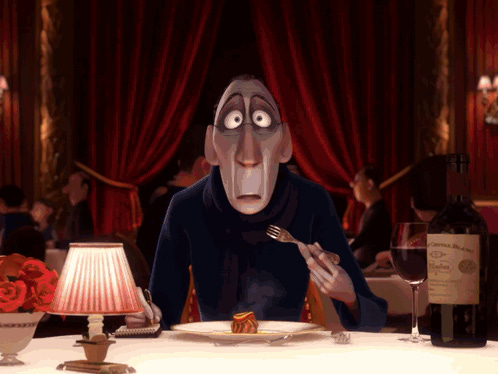
I froze awkwardly...
I hate explaining my quirks on the spot and in all honesty, no—I didn’t want to watch Ratatouille.
I’ve always been afraid of Pixar films. And if I said that to my friend, it would also violate “Saying yes, and to things”. With my new philosophy on fear being the only way out is through, I said yes and sat down for the movie. For the first time, I was going to fully watch Ratatouille.
As the movie began, I sat and asked myself why, why at the big age of twenty-one years old, was I still so unsettled by animation? If I wasn’t afraid, why couldn’t I just sit and watch it. So I challenged myself, and within seconds I got the plot. A rat who longs to be a chef, trapped in a body and a story that should disqualify him, follows his intuition until he becomes what he desires. I had always known the plot, but immersion felt different. Feeling the story was different. It made me think: animation does not just entertain children. It teaches them how to carry heavy truths and weigh them in the overall narratives of life.
My thoughts drifted back to my own childhood. Even as a toddler, I carried this restless hunger for adulthood. I could see the difference between myself and those in charge(my parents, aunts, uncles, grandparents). They dictated when I ate, when I slept, what I wore, where I went. From the beginning, I was determined to wrest control over my life. Baby shows felt like they were “dumbing” me down…I wanted to see adult stories. I wanted to mimic and study how they talked, walked, and carried themselves. Part of this came from my Ma, who helped raise me in those years. She forced me to pass time with her watching films and soap operas. Ma is the ultimate cinephile and soap opera devotee. For fun she loves counting her money (stashing bills in five-gallon water jugs she hides in plain sight), smoking Newport cigarettes every half hour, ordering things seen on TV, and winning solitaire games. She meticulously organizes her film collection with a Sharpie and label-maker. She’s both a pain in the ass sometimes and one of the funniest, sweetest people I know.
When I grew old enough to piece together the narratives, Ma leaned in harder. Out went Sesame Street; in came The Young and the Restless, Days of Our Lives, Titanic, and Roots. My mom still laughs about how three-year-old me would retell my adventures from Ma’s house and deliver elaborate retellings of betrayals and romantic twists. By elementary school, films had already become my way of making sense of the world. Thanks to Ma, I learned to ask my dad questions about death, love, grief, betrayal, and power—and receive answers within the safe container of a story. Riding in the backseat of another life gave me mastery over my own words and position in the world. Some children find this in books. But I found it in film first.
And yet, no matter how many movies I watched, I rarely saw myself. I could borrow traits, admire dreams, but the skin between us made me invisible(atleast I felt that way). That feeling of invisibility bred my distrust of animation. If I couldn’t belong in reality, how could I belong in universes where toys plot against their owners, cars have popularity and are forgotten in hayfields, or joking monsters enter kids bedrooms through portals? Animation was too unpredictable, an abyss of imagination far too detached from the rules of reality I was so desperate to decode and master. So I dismissed it all as nonsense, because it’s easier to suppress than address. But beneath that dismissal was masked fear. Fear of worlds I could not dominate. Fear of art that required some surrender. Surrender that required losing control.
In confronting that fear, I learned one important thing: Ratatouille is a beautiful film. It teaches children not to let race, gender, or nationality dictate who they can become. A rat, reviled and mute to humans, can rise to the top of French cuisine. If he can be anything, then so can we. I feel a tenderness for my younger self, who believed she had no control. By turning away from these films, she stunted her creative development, clipping her imagination before it could stretch into the abyss. Now I see: the only way through the fear is to return to those stories and let them teach me again, this time without running away.
» Unless you get an Uber eats order for $8, which unfortunately I’m yet again your friendly bay area neighborhood uber eats driver, so I did not actually finish Ratatouille— quest continues.