

Weekly Catch #5 🎣: A Hamster No More
atleast not for the next few months

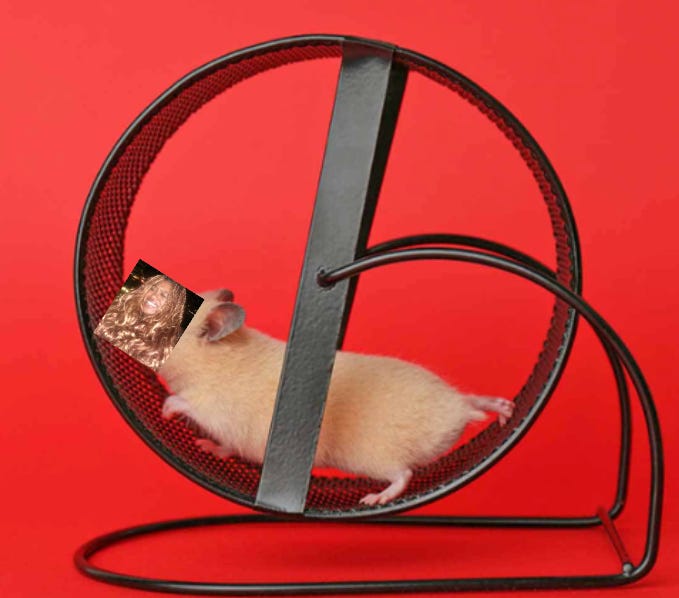
Back home I was a hamster on a wheel, constantly running, grabbing water breaks when I could, and the moment I stopped running, one of two things happened:
1) Bad Things: Hunger, despair, illness, chaos—or worse, a total crash. Maybe my body gave up, maybe i’d been running for so long I never connected with anything around me. This is because when forced to get off the wheel, I’d notice I wasn’t actually living at all.
2) Great Things: Warmth, knowledge, music, creation, sounds, love, fun, smelling earth, smelling people, tasting food, running around the world, learning from others, and wild inspiration to explore.
Since moving to SF and ditching my old cage and wheel, I haven’t really known what to do with myself—so, in a way, I’ve spent the past three weeks building myself a new cage and wheel. I pulled up and immediately threw myself into a system: mornings grinding on some SOULR-related app or writing on SST to “make progress,” spending afternoons with music to touch my soul. By last week, I’d officially burned out of that shit... I was so lost at Nautilus because I was supposed to be here for freedom. So I was at odds with myself on why that “freedom” didn’t feel good. I realized I’d just recreated the same problems that existed in my “real world” —minus school, relationship drama, and work.
It finally clicked when I told a friend how fuzzy everything felt, how I had zero headspace to process and think about what I wanted and how to tangibly get there. The real recipe for jumping off the wheel—healthily and replenished is creating space for thinking, self-care, and continuous play. At home, the hustles chokes out creativity and creates agitation, I was never truly productive on the wheel- I was just busy keeping myself active. But now? I can stop, breathe, and let curiosity and love lead the way. That’s where I believe the magic will happen, and I can’t wait to keep you posted on what life is like when I can truly run free, no cage or wheel.
Writing Doom
I usually cannot tolerate the bad acting in typical low-budget short-films, but this had a lot of funny gems. I think if you’ve had experience in AGI or ASI debates/conversation, you’ll find this amusing. Lots of beautiful gems like:
“You're probably not an evil ant-hater who steps on ants out of malice, but if you're in charge of a hydroelectric green energy project and there's an anthill in the region to be flooded, too bad for the ants. Let's not place humanity in the position of those ants.” — Stephen Hawking (unfortunado we are the ants)
Innovation and Repetition by Rene Girard (Cluny)
We’ll dive deeper tomorrow in a Thiel v. Girard comparison, but here are some takeaways from Girard’s essay:
1. Innovation was once heresy
“In theology… innovation is practically synonymous with heresy.”
“Orthodoxy is unbroken continuity and, therefore, the absence of innovation.”
Girard shows that, until the Enlightenment, “innovare” meant an interior renewal that threatened fixed dogma—any change was suspect, even criminal.
2. Innovation and imitation are inseparable
“To be innovative and to be imitative are two incompatible attitudes… This conception is false…The mimetic model of innovation… depends on the kind of passionate imitation that derives from religious ritual and still partakes of its spirit.”
True novelty always builds on prior models, our urge to copy sparks the spark of real invention.
3. Competition turns copying into creation
“Competition… means to seek together. What all businessmen seek is profits; they seek them together with their competitors in the paradoxical relationship that we call competitive.”
“The only short-cut to innovation is imitation.”
In market economies, firms survive by mimicking their rivals, and often discover brand-new breakthroughs in the process.
4. Avant-garde’s anti-mimetic “terror” backfires
“The eternal avant-garde has waged a purely defensive and ultimately self-destructive war against [imitation].”
“The so-called counter-culture of the sixties… was a revolt… against the very principle of education.”
By insisting on absolute rupture with the past, modern artists often hollow out their own innovation, ending up trapped in endless self-cancellation.
5. Lasting change must spring from tradition
“Real change can only take root when it springs from the type of coherence that tradition alone provides.”
“The main prerequisite for real innovation is a minimal respect for the past, and a mastery of its achievements, i.e. mimesis.”
Girard’s final verdict: innovation devoid of its roots in tradition is as futile as a plant trying to grow with its roots in the air.
The Not So [Secret Life of Walter Mitty]
“To see the world, things dangerous to come to, to see behind walls, draw closer, to find each other and to feel. That is the purpose of life.” — theme in movie
I really didn’t like this movie and fell asleep 45 minutes in, the nature of it’s content should have made it a short film (or I was just bored). I think the reason one of my GPTs recommended it was because I live in my head a lot, and that fully encapsulates the life of Walter Mitty. I think as a film it gets old, but living in your head gets old to. A mental experiment that I’ve been running is that when playing a potential scenario out in my head, how can I bring the most consequential potential into reality?
Religion Is Poetry
I frequently say that the bible is best read not as a literal wiki, but as poetic/prophetic literature.
If you’ve spoken to me in the past week, you know I’m a new fan of James P. Carse:
Religion is pure poetry: “Religion in its purest form is a vast work of poetry.”
Belief ≠ Religion: “You can be religious without being a believer. And you can be a believer who’s not religious.”
Belief systems burn bright and die fast: “Belief systems have virtually no longevity. Think of Marxism. As a serious political policy, it lasted only about 70 or 80 years. Nazism only went 12 years.”
In Infinite and Finite Games, Carse argues that belief systems are products of society and society is finite. Art is a product of culture, and culture is infinite.
Mystery fuels millennia: “The reason the great religions don’t run out as quickly is that they’re able to maintain within themselves a deeper sense of the mystery, of the unknowable, of the unsayable, that keeps the religion alive and guarantees its vitality.”
No one-size-fits-all blueprint: “Modern scholars have almost unanimously decided that there is no generalization that applies to all the great living religions.”
“When the warmth of your palm and the texture of your hands
build a fire in my chest
When your eyes become telescopes
to hidden constellations
When your scent pulls me
into the gravity of your unknown”
🔊 BOTW:
If you happen to attend my future wedding, I want to have a big symphony and gospel choir sining from 2:45 till the end :) Swiping left on the tradition of Pachelbel's Canon in D, we balling to “I have waited my wholeee life”
Notable Mentions:
Have a great week Thought Fishers!!
Catch me in these places:
Call Me: (864)-907-9757 - I don’t bite, and love convos so just do it man!
IRL: SF in South Park @Nautilus (lets get drinks/snacks, talk, and chill)
X as @philosofounder (girard 4 techbros)
Insta also as @philosofounder (mi vida loca)
Spotify as @mkhastaste (listening party?)
(in need of a new book/film app but I love those too)