

Weekly Catch #1 🎣: Introduction
+ pre-Nautilus nerves, Jony Ive, Girard, Kobe, & evolution args

Welcome friends. Since this is the first cast, let me reel you in with a bit of context.

I’m MacKenzie Michelle Fisher. Lately, I’ve been calling myself a philosofounder—philosopher who is building things to test my intuitions.
I studied philosophy for three years formally, exploring every major thinker, religion, concept, and system. Since 15, I’ve worked full-time in early-stage startups—product, growth, ops—because I believe activism and government are slow, inefficient, and corrupt. To make the world freer and smarter, we must build it. I love technology and innovation. I resent educational institutions, but school was mandatory. As an adult, it brought me to Silicon Valley for free, and now I’ve unlocked a free apartment and free degrees on demand anywhere.
For now, I’m done with that! Headed to Nautilus next week for a 3-month deep-dive program for scientists, builders, and artists. I’ll be using it to focus and launch my first system apps(Orbit/Onyx)for SOULR OS.
This newsletter is where I document the ride. Every week, I’ll share 7 things I’ve learned or loved: moments, ideas, songs, books, arguments, quotes, and updates on what I’m building.
Let’s fish.🎣
📣Announcements/Updates:
Well… the cross-country launch film-in-a-week idea flopped😅 Timing wasn’t right, but that’s okay.
New launch plan? I’ll share publicly once I’m done raising money.
Directing wise: I’m making a 3-minute short for my 102-year-old great-grandma. This is my tribute to her as a metaphysician showcasing love across time, space, and legacy
☕️ Café Socrates: Café Socrates is an open Socratic dialogue where we explore one topic critically, for two hours each Sunday 3-5pm. Come and go as you like.
For now, I’ll host on X Spaces and post recordings on Substack, but it may evolve into an in-person event in SF.First topic drops next week.Stay curious.Vote below!
💭 1. Life Update: Pre-Nautilus Nerves
A lot of people see me as social. Outgoing, even. But the truth is, I’ve spent a lot(a lot) of time in solitude, by choice and sometimes necessity. Over the past year, falling in love with my work has made me more internally grounded, but it’s also pulled me out of practice socially. I love community, but I’m still learning how to bring my authentic self into the presence of others without diluting.
Maybe you’ve felt this also: before I took philosophy seriously, I never really felt out of place socially, because I was conforming. I had a ton of friends, but was very alone. I outsourced curiosity for comfort. I mimicked what was safe. But over time, that safety cost me authenticity. That’s partly why I resonate so deeply with René Girard. Mimetic desire isn’t just a theory,it articulates a prison I’ve lived and escaped.
So I’m practicing something new: trusting the self I’ve spent years uncovering—not just in solitude, but in communion. My mentor, Zelda, recently reminded me: we all wear masks. The key is choosing which parts of ourselves to reveal, and when. That’s not inauthentic—it’s intention.
As I head into this new chapter, I’m not aiming to bare everything. I’m aiming to show the right sides of myself—the ones most alive, most aligned—for this next environment.
This season is an experiment in integration. In showing up fully, without performing.
It’s thrilling. It’s terrifying.
But I’m ready to go:)
🔍 2. Deep Dive: Jony Ive
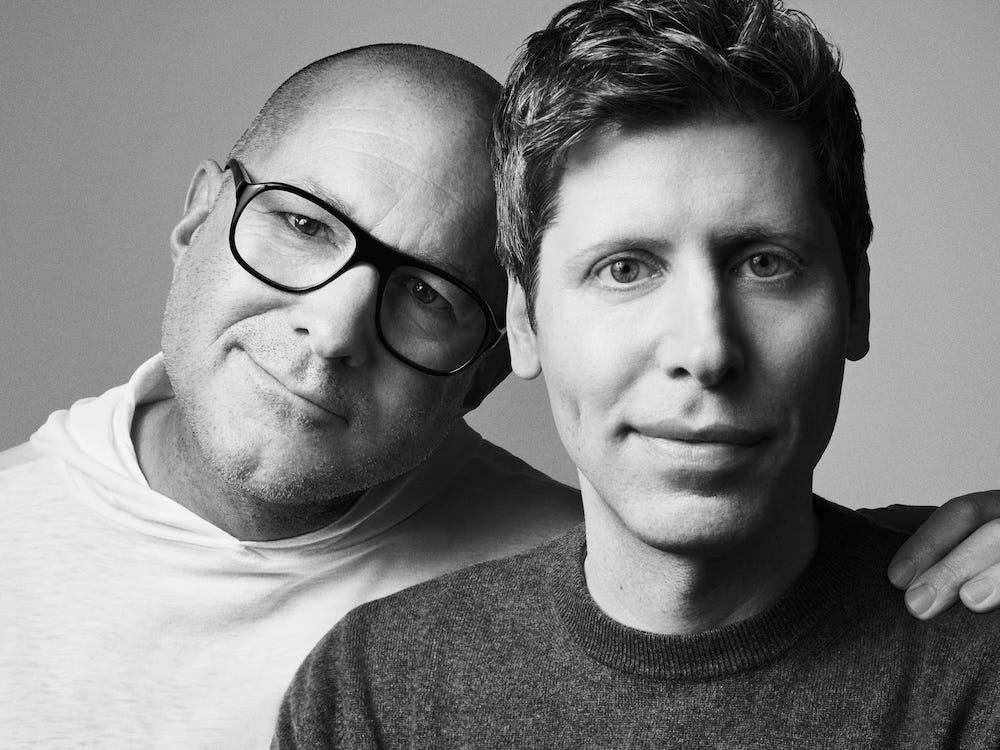
Jony Ive isn’t a god or some unreachable design deity.
He’s a man—a toolmaker—who brought care into the core of consumer tech.Here’s what I’ve learned from my deep dive(linked here):
1. Design is a Mirror of Values
“What we make stands testament to who we are.”
For Ive, every object reflects its maker. If what you build is chaotic, careless, or shallow, it’s a signal of internal disorder. His north star? Serve humanity, not just markets.
2. He’s a Toolmaker, Not a Breaker
“I have no interest in breaking things. I’m interested when things are broken as a consequence of creating something better.”
Silicon Valley worships disruption like it’s a religion. But Ive is a kind of secular monk in contrast—interested in continuity, evolution, care. His aim was never to break the world, but to refine it.
3. Care Is the Glue
He called it “an innocent euphoria”—the feeling of building with like-minded people in service to humanity. That’s not just poetic, it’s pragmatic. Teams that care about each other and what they’re building design differently. The outcome isn’t just more beautiful; it’s more human.
4. Invisible Functionality > Flash ✨
Great design disappears. That’s an Ive hallmark. From the click of the iPod wheel to the haptic feel of the iPhone, everything had to feel right, even if you didn’t consciously notice it. His inspiration? Dieter Rams—whose principles include: “Good design is as little design as possible.”
5. Simplicity Isn’t Minimalism—It’s Meaning
“Simplicity isn’t just removing clutter. That’s how you get minimalism. My goal is to bring order to chaos and succinctly express the essence of something.”
Ive didn’t want sterile. He wanted succinct. There’s a difference. Simplicity, to him, was about coherence, clarity, and joy—a quality often mistaken for triviality. He fought to keep humor, warmth, and delight alive in cold machines.
6. He’s Not a Genius—He’s a Devoted Craftsman
Jony Ive went to art school in England. He sketched. He failed. He iterated. His big ideas came not from grandiosity, but from relentless care and humble collaboration. He reminds us: you don’t have to be a god to do god-tier work—you just have to care more than anyone else.
Ive reminds us: beautiful things come from those who care deeply—not just those who think differently.
📚 3. What I’m Reading: I See Satan Fall Like Lightning - Girard
1. Mimetic Desire and the Inversion of Prohibition
Rather than treating biblical commandments as static legal codes, Girard interprets the Tenth Commandment (“You shall not covet”) as a revolutionary insight into the nature of desire itself. Desire is not oriented toward objects in a vacuum; it is always shaped through others—through models. Jesus does not merely tell us what not to desire; he redirects our attention to whom we should imitate. This sharply contrasts with pagan or mythic religious systems, which hide the victim at the center of desire and power.
“THE TENTH COMMANDMENT signals a revolution and prepares the way for it. This revolution comes to fruition in the New Testament. If Jesus never speaks in terms of prohibitions and always in terms of models and imitation, it is because he draws out the full consequences of the lesson offered by the tenth commandment. It is not due to inflated self-love that he asks us to imitate him; it is to turn us away from mimetic rivalries. What is the basis of imitating Jesus? It cannot be his ways of being or his personal habits: imitation is never about that in the Gospels”
— Girard, René I See Satan Fall Like Lightning (p. 13)
2. Freedom to be Human through Mimesis
A critical aspect of Girard’s anthropology is that mimetic desire is a requirement of human freedom. If desire were instinctual, as in animals, there would be no transformation, no development, and no culture. The flexibility of mimetic desire is what makes human learning and civilization possible.
The implication is twofold: mimetic desire enables transcendence of the merely biological, but also makes human beings vulnerable to rivalry, competition, and violence. The scapegoat mechanism—later thematized in Things Hidden Since the Foundation of the World—is precisely society’s ancient response to un-contained mimetic conflict.
If our desires were not mimetic, they would be forever fixed on predetermined objects; they would be a particular form of instinct. Human beings could no more change their desire than cows their appetite for grass. Without mimetic desire there would be neither freedom nor humanity. Mimetic desire is intrinsically good. Humankind is that creature who lost a part of its animal instinct in order to gain access to “desire,” as it is called. Once their natural needs are satisfied, humans desire intensely, but they don't know exactly what they desire, for no instinct guides them. If desire were not mimetic, we would not be open to what is human or what is divine. Mimetic desire enables us to escape from the animal realm. It is responsible for the best and the worst in us, for what lowers us below the animal level as well as what elevates us above it. Our unending discords are the ransom of our freedom.
— Girard, René I See Satan Fall Like Lightning (p. 15)
As Jonathan Bi summarizes, mimetic desire is both the origin of culture and its greatest threat. Its duality must be negotiated, not denied.
3. The Satanic Function in Cultural Desire
Satan for Girard functions as a seducer not because he introduces evil per se, but because he models transgressive freedom. He sanctions desire unmoored from ethical orientation, and then weaponizes it into rivalry. Satan incarnates the cycle of desire, rivalry, and scandal.
“He wants first of all to seduce. Satan as seducer is the only one of his roles that the modern world condescends to remember a bit, primarily to joke about it. Satan likewise presents himself as a model for our desires, and he is certainly easier to imitate than Christ, for he counsels us to abandon ourselves to all our inclinations in defiance of morality and its prohibitions. If we listen to Satan, who may sound like a very progressive and likeable educator, we may feel initially that we are “liberated,” but this impression does not last because Satan deprives us of everything that protects us from rivalistic imitation. Rather than warning us of the trap that awaits us, Satan makes us fall into it. He applauds the idea that prohibitions are of no use and that transgressing them contains no danger. The road on which Satan starts us is broad and easy; it is the superhighway of mimetic crisis. But then suddenly there appears an unexpected obstacle between us and the object of our desire, and to our consternation, just when we thought we had left Satan far behind us, it is he, or one of his surrogates, who shows up to block the route.”
- Girard, René I See Satan Fall Like Lightning (p. 33)
The model is transformed into the scandal (skandalon), a source of both fascination and impediment. Addiction provides a clarifying example: the first encounter with a substance is nearly always mimetic—a peer models it, a cultural script legitimizes it, and desire is awakened through mediation. The drug, like the seducing model, offers intensity, identity, even transcendence. But as use turns to dependence, the drug no longer represents liberation—it dominates the will, becomes the rival within, and dismantles agency. Where is the liberating figure now? Absent. The model vanishes, and Satan reappears as the adversary. This collapse from seductive imitation into self-destruction is precisely the mimetic trap Girard names as satanic.
4. Postmodern Difference and the Loss of Structural Insight
The final passage confronts postmodernity’s failure to distinguish myth from Gospel. Where structural anthropology once emphasized commonality—ritual, myth, sacrifice—contemporary critics elevate difference to the level of dogma. In so doing, they efface the real epistemological rupture that Girard identifies between the mythic concealment of the victim and the Gospel’s unveiling of the innocent scapegoat.This blindness reinforces the mimetic structures it fails to name. By suppressing the victimage structure that unites mythologies across time, we lose the ability to recognize how violence is sacralized and perpetuated—even in secular forms.
“Postmodern opponents of Christianity don't try to demonstrate that the Gospels and myths are similar, identical, or interchangeable. Differences don't trouble them, and in fact they pile up differences with ease. It is rather the resemblances that they suppress. If there are only differences between the religions, they make up just one big undifferentiated conglomerate. We can no more say they are true or false than we could say a story by Flaubert or by Maupassant is true or false. To regard one of these works of fiction as more true or false than the other would be absurd. This doctrine of insignificant differences has seduced the contemporary world.
- Girard, René I See Satan Fall Like Lightning (p. 103).
Consider a typical mythic narrative, such as in The Iliad: order is restored through the violent elimination of a disruptive figure. Whether it is Hector’s death, or a villain defeated by the heroic lone savior, peace comes through righteous violence. This structure mimics the archaic sacrificial logic Girard outlines. Christianity, by contrast, centers on the unjust execution of an innocent human—Jesus—and insists that the mob, not the victim, is guilty. The Resurrection is not just theological affirmation; it is an anthropological exposure. It unveils the scapegoat mechanism as a lie.Thus, Christianity is not “just another religion(myth)”. It is the revelatory exception that undermines the sacrificial logic which all other systems rely upon—religious, political, or ideological. In Girard’s words, it is “the end of myth” and the beginning of the possibility of history without violence as its founding logic.
🎬 Challengers

I’m always surprised when a sports movie grabs my attention. But let’s be real—it had Zendaya, and at this point, any movie with her in it is going to be great haha.
What Challengers did so well wasn’t just the tension of tennis—it was the tension of power, love, and ego. One theme that struck me as fresh was the dehumanization of men. There’s something brutal and honest about how the film explores insecurity—how hate only produces more hate, and how seductive power becomes when you’ve finally escaped the pit you were once stuck in.
And yet... we pull others back down.
Out of fear. Out of habit.
Out of a warped sense of justice.
Zendaya’s character? Probably the most dangerous villain I’ve seen in a while. Not in the obvious way—but because of how normal her manipulation looked. Because of her beauty and charm, she could wreck two friends and never get blood on her hands. She didn’t need to shout, or swing a racket. She just needed to exist with enough precision to tilt the balance.
It left me wondering:
What does subtle evil look like in everyday life?
How often do we let charisma excuse cruelty?
How often do we perform love while actually playing power games?
Watch it. Then sit with it. Challengers isn’t just a love triangle—it’s a mirror. And it might make you squirm.
🔊 BOTW: Zarigani
Notable Mentions
📼 Kobe On Failure
Let's hear from the champ on how we can all win:
Interviewer: “There’s players who love to win, and there’s players that hate to lose. Which are you?”
Kobe: “I’m neither. I play to figure things out. I play to learn something. If you play with the fear of failure or with the will to win- it’s weakness either way.”
My high school debate coach, Lorenzo Barberis Canonico once taught me something I'll never forget: "Play to win, don’t play not to lose." People often play not to lose because it sucks and is embarrassing. But when you stop fearing loss and believe there's always something to gain, you can never truly lose. Kobe echoes this sentiment—if you see every game and every system as an opportunity to learn and get better, there's no stopping you. At the end of the day, it's always you vs. you. You will never fail, you’ll grow.
🧪 Mind Gym: Evolution Refutation Challenge
I love science, and a core part of the scientific mindset is rigorously testing ideas – even foundational ones. Recently, I came across some interesting arguments that raise objections to aspects of evolution (shoutout to Bentham's Bulldog for the food for thought!).
This week’s challenge is for you to dissect these arguments. Are they sound? Where are their weak points? How would you respond? Let's see if we can make the understanding of evolution even more robust by pressure-testing it. The most insightful analyses will get a spotlight!
Your task: poke holes in the argument for evolution—or patch the ones others point out.
🧬 Argument #1:"We've Never Actually Observed Speciation!"
A common objection to evolution is the claim that we haven't directly witnessed one species splitting into two distinct, reproductively isolated species, especially not in a laboratory setting. The argument often goes something like this:
Every organism is the same species as its parent(s).
If A is the same species as B, and B is the same species as C, then A is the same species as C. (This is the transitive property).
Therefore, all of an organism’s descendants are the same species as that original organism.
Evolutionary theory proposes that speciation (the formation of new and distinct species from an ancestral species) occurs.
Conclusion: Since (3) suggests species remain fixed, and evolution (4) requires them to change into new species, evolution must be false.
Your Challenge for Argument #1:
Examine the premises: Are they all accurate and universally applicable as stated?
Consider Premise 1 ("Every organism is the same species as its parent."): While true for immediate offspring, what happens to the concept of "same species" when considering a lineage over thousands or millions of generations with accumulated genetic changes and potential geographical separation?
Think about Premise 2 and its application: Does the concept of "species" (especially under the Biological Species Concept – groups that can interbreed) always behave like a strict mathematical identity across long chains of descent? What about "ring species"?
Is the assertion "We’ve never observed speciation in a laboratory" factually correct? What kind of organisms or experimental setups might allow us to observe evolutionary changes, including steps towards speciation, on human timescales?
If speciation is often a very gradual process, how would that impact our ability to "observe it happen" in a single moment? (Consider an analogy: if a wall's color changed from red to orange incredibly slowly, would you see a specific instant of change?)
➡️ How would you poke holes in this argument or defend evolution against it?
Argument #2: "Evolution Violates the Second Law of Thermodynamics!"
Another claim sometimes leveled against evolution is that it contradicts the Second Law of Thermodynamics. The reasoning is:
The Second Law states that the total entropy (a measure of disorder or randomness) of an isolated system can only increase or stay the same over time.
Evolution describes an increase in complexity and order in living organisms over eons.
Therefore, since life becomes more ordered, evolution violates the Second Law.
Your Challenge for Argument #2:
What are the precise conditions under which the Second Law of Thermodynamics applies? Specifically, what does "isolated system" mean?
Is the Earth, where life evolves, an "isolated system" in the thermodynamic sense? Why or why not?
If the Earth is not an isolated system, how does that affect the argument that evolution violates the Second Law? What inputs might allow for localized increases in order (like the complexity of life) without contradicting the law?
The statement "entropy only increases in a vacuum" was part of an earlier version of this objection I saw. Is "in a vacuum" the correct or most relevant condition for the Second Law? Why might that be a misunderstanding?
➡️ How would you assess the validity of this objection? Explain why it does or does not hold up.
(Best replies will get a shoutout in next week’s newsletter as Catch Of The Week:)
Have a great week Thought Fishers!!
Catch me in these places:
IRL: SF in South Park on June 1st (lets get drinks/snacks, talk, and chill)
X as @philosofounder (girard 4 techbros)
Insta also as @philosofounder (mi vida loca)
Spotify as @mkhastaste (listening party?)
(in need of a new book/film app but I love those too)