

hsm_greatest_failed_art.epI
A letter to return to freedom and love

To anyone who will Listen,
I want to tell you a story involving numbers. Through it, you might see the complex stories that numbers can’t hold, but also what they reveal about us as humans and beyond. It feels like a long way around, but a story is the only way I know how to get you there.
Numbers we trust. In an age where we are conditioned to rely on data and legibility to appreciate art, I’ve found myself wondering: how do we describe transcendent success without them? I found my answer in these testimonies:
“It was life changing.”
“It helped me fall in love with myself.”
“It empowered me, made me believe in my dreams and possibilities.”
“There hasn’t ever been a place I’ve traveled to in all 20 years where someone hasn’t told me thank you.”
.
.
.
This is feels infrequent in 2ø26. Have you genuinely said “Thank you” to any product or art recently that changed your life? How long has it been since an art or technology disrupted your life for better? How long has it been since you’ve heard something that made you dream and love yourself, but most importantly—to truly have faith.
This project in particular was the global phenomenon of 2006, the best selling album of the year, the first movie for sale on the iPhone, and the first billion dollar Disney Channel live-action musical to pave the way for many tv/film-musicals after.
With $4 billion in sales globally in their first five years. They broke Madonna’s merchandise record, sold out faster than every pop group, they played stadiums across Central and Latin Americas with crowds of thousands…93 thousand people in one place singing and dancing along with the group in São Paulo, Brazil.
Kenny Ortega (director)1 said in reflection on this unifying success, “we knew something had happened”::..:…Something. Yes indeed, happened.
High School Musical.2
When HSM started advertising in 2005, recommendation algorithms as we know them didn’t exist yet. HSM was one of the last global monoculture hits. There was no algorithm to fragment viewers into categories of who might like it before premiere so everyone was shown the same ads on Disney platforms at the same time. going from 7.7 million unique viewers on premiere to 300 million worldwide.3
HSM was written as a play in 2004 by Peter Barsocchini for his 10 year old daughter and her friends. Barsocchini didn’t know that high school was the same globally while writing. As many artists’ experience, its’ universality was a discovery in exposure. Barsocchini was inspired by everything around him, his own high school experience, his writing, but more importantly his why of communicating a particular message.
During a bus ride home in high school, a teammate confided in Barsocchini —half-joking, half-threatening— that he’d always wanted to be a ballet dancer, but he suppressed that dream out of fear of his community.
This teammate ended up with 5 Super bowl wins and 1 MVP award...
When I heard this, I could only imagine what more he could have been with ballet in his pocket? I imagined all the more people4 he’d inspire to shamelessly dance, what combinations he could’ve felt, what grace in his spirit, what unexpected power he’d discover in that duality?
We’ll never know.
.
Because he never got to find out.
.
That’s the cost of staying within someone else’s boundary.
“It was a different world back then than we have now. People are more inclusive.5 If the star quarterback wants to join the school musical–nobody bats an eye. Back in 2000, 2002, people would have gone crazy.”
- Barsocchini sharing his mindset in 2004
○ Heard, Didn’t Listen
Maybe this is contrarian. Maybe I over-analyze…
But I’m sorry Barsocchini, twenty years later—we’re all still putting each other in boxes.
I’d argue, with more information, we have even more boxes and only tolerate certain outliers. We inherit and reproduce “prescribed” labels to enforce definitions and images on people in order to understand them. If you happen to be multifaceted, which we all could be, you end up labeled or reduced with archetypes stacked on your identity for legibility.
HSM went viral at the exact moment the environment was evolving. Remember in 2005, everyone was watching the same ads, the same premieres, talking about the same things. Everyone was already repping their interests as their core identity, before algorithms would begin to fragment us into our own feeds. Platforms were just newly able to lock us down in this cycle where their survival rests on keeping our attention. But hey, that is the goal of most corporations and media anyways…
Algorithm ate the Medium
Social media was supposed to be our next environment, but our beloved apps are currently collapsing in value with our overpopulated global village. The myth of “connection” and “discovery” has been killed. Where are we all supposed to play and relate with humanity at scale?6
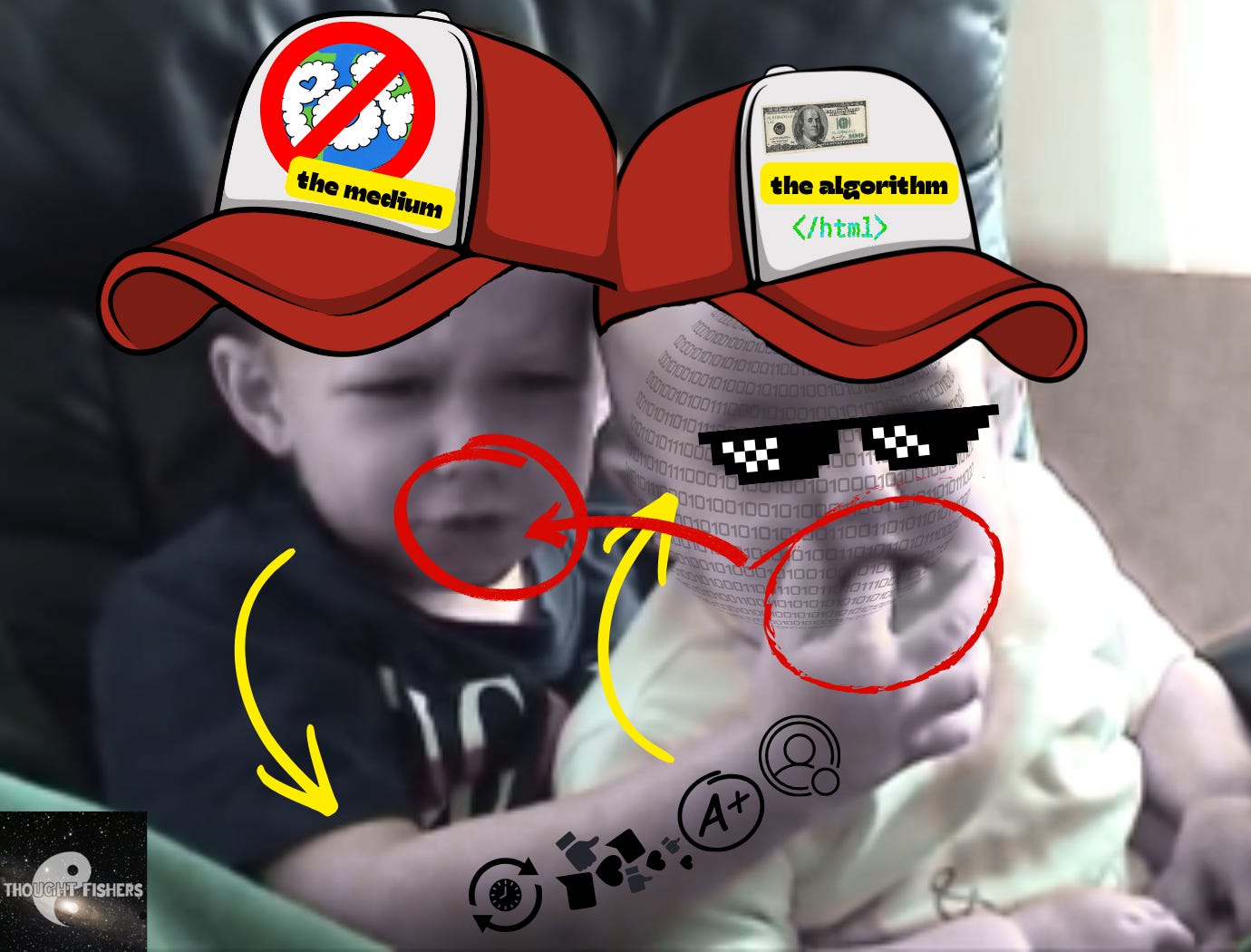
A medium is the environment that shapes how humans relate to each other. In 2005, when HSM first was advertised, the medium was becoming a cyclical pipeline between IRL and URL—you would consumed the “content” online, then you had to take agency in real life.7
For example, kids didn’t just watch HSM on YouTube, they performed the songs at school talent shows, bought the toys and clothing, created fan communities IRL. They listened to the soundtracks together, and sent letters to the team. This pipeline was reinforced through the handoff between screens and the physical world. They needed each other to reinforce presence in the other.
The pipeline appeared balanced for a period.
The pipeline resolved the bottlenecks of the early internet and media age. Their built-in limitation was: you participated mostly anonymously, at home. You were a fan online, your “real self” online, but the world never really saw “real” you. The exposure “users” got online wasn’t enough to disrupt their concept of reality. You could log off, close the screen. You could go outside, leave the digital world easily, parents and friends would persuade you to go play. You could move on, and come back on your own terms and boundaries.
Boundaries.
Then Twitter launched in 2006, the same year as HSM.
It was a continental rifting of the people of Earth, but with passion and new senses of wonder we turned it into the global village it is now, and with the previous content of the internet/media age—this village was alive. Instagram came four years later. TikTok, ten years musical.ly after that. Social media was just beginning.
HSM had perfect timing. Disney’s distribution got everyone watching8, the url content shaped personal identity, and irl concerts/plays/shows created real community. Then, social media let fans amplify it all. The cycle was working. Working way too well. Corporations9, decided that on either end of the pipeline—whoever could monopolize presence or ignorance of their users would make the most money in the digital age. Thus, the digital race for attention began and the medium started to be eaten by the algorithm.10
US:
“the United States is probably caught completely between these technologies, and has not a clue what to do with the new in terms of the old…
anymore than our postal department knows what to do with the old hardware technology in relation to the new software.”
- McLuhan, Garbage Apocalypse (1970)
Social media was never equipped to house a global village at scale.11 Without the right tools to manage our information society, we never evolved our village into a civilization. Still mobbin, as most apps aren’t designed as environments for humans to connect in a human way12, they must reduce all data into own systematic scoring systems for humans to perform in for evaluation based on what behavior they want to produce13. Some apps are better at letting us play and communicate—like TikTok or Twitter—but even these are terrible examples; both with their own trade-offs.
Pay Attention to the Values of Your Technology
“Technology is neither good nor bad, nor is it neutral.”
- Melvin Kranzberg
Technology is not value neutral14. Every invention on Earth has a creator, and every creator has values. Values determine how goals are steered— filters, what it incentivizes, how it prompts you to act.
Think of your phone like your personal game controller for living. Its job should be helping you play with your agency. Instead, it's playing you15...
The Real real…
Corporations and teams do need to make money, that is the game of creating value. Most even started with good intentions for what value they create, but good intentions don't prevent unintended consequences.The desire to make as much money as possible and to have all desires satisfied are at odds with each other morally—yet in norm, appear very compatible financially on a bird’s eye view of our timeline. However, what is lost is the god’s eye view, the millennia, the arc of the human story.
Social media is “free” because You are the product—your attention, your agency, your mind…This business model doesn't require any evil intent from most participants, only basic economic logic and fear: platforms bake in corporate friction in between you and your device—long nonsense contracts, scary notifications, infinite scrolls, and miss-recommendations because that's what keeps the lights on, so they think.
The illusion is…they can’t empower people to be Free to create their own sustained lives and expect to maximize profit16—they’d lose Control. The system survives by letting just enough people “make it”17 to sustain the world, giving all else hope they too can tread down a pathway of their creation; hop online or get just get noticed and “you can win” by paying for anything and everything. All can be bought.
At all costs, they want your attention. Even if it makes your products harder to use. Even if your communication becomes more complicated than ever. Even if we need to fast and detox away from our own tools that were meant to empower us with agency. The revenue extracted is just enough to keep platforms alive and us addicted and delirious, while our actual values get buried under metrics we don’t know we are chosing.
Their goal is: Capturing our values
We feel these urges to scroll, check our notifications, stare into blue light, optimize ourselves for likes, and even ghost around because we’re afraid of not getting any love. We're addicts paying good money to people we protest, for companies and products we don't even like, in exchange for dopamine services we know are destroying our humanity.
C. Thi Nguyen18 calls this 'value capture'—when external institutions secretly replace our desires with theirs. You go online wanting rich, complex values: connect, play, friendship, love, self-improvement, learning. But you get distracted by shiny models in the marketplace, overwhelmed by so much to consume, watching who you could be. To make this efficient, before actualization your desires get replaced by thin, crisp metrics: followers, likes, reposts, comments, and in return these metrics become the goal we pursue. We inevitably want to leave ‘social media’ when we eventually realize we’re chasing validation of proximity to 'what we want' instead of actually wanting the process of getting it.
On this hamster wheel, we forget there was ever anything else. We're drinking poison and calling it water, spitting it out and drinking more. This confusion—between what our bodies tell us we want and what we actually need to be fulfilled is the gap that is exploited for control.
Dropsy at Scale
Descartes warned us centuries ago with divisibility.19 He claimed the mind and body are divisible: you can lose your arm or shed skin cells daily, but the mind is indivisible—you can’t lose ‘part’ of your mind and remain the same substance. This is why the body deceives us.
Like someone struggling to fight alcoholism, a person with dropsy feels an unquenchable thirst for water even though they know drinking more will kill them. Their body 'lies' to their mind because, while they are overloaded with fluid, that fluid is trapped in their tissues rather than circulating in their blood, triggering a false signal of dehydration.
Our algorithmic age is dropsy at scale.
We surrender to these urges even when we know how we truly feel upon reflection.
I know there is truth in Descartes phenomenon of divisibility, it feels real. Your body can be fragmented, mutilated, measured, and divided. But it isn’t until we lose our minds that we forget who we are. I don't think we can practice being human broken.
Social media gamifies our communication—turning people into content, private conversations into public debates, and connection into competition for likes and comments. We optimize for engagement metrics, not anything real or complex. We rarely treat people online with the same dignity we'd extend to humans in person.
You think you’re safe from this, not participating online? As I mentioned before, “online” didn’t create this.
We’re all walking around fragmented before, and now:
School you is → Achieving things. Measured by grades, test scores, awards, college acceptances. Do you love learning or competing and feeling better about yourself?
LinkedIn you → Professional. A classic man.20 Get those connections, claps, endorsements. Build that network, in time net worth;)
Instagram → Aesthetic You. Mysterious, lowkey, cool—or so you want us to think... We don’t know the real you. Maybe we’ll make it in your “close friends.” But between us, they own you there too. Count your followers, likes, posts, and compare.21
Twitter/X/TikTok → Discourse. Comedy. Knowledge. Very informed. Very cold. Very aware. Always watching. Measured in retweets, viral moments, diverse models to copy, finding new “facts” to perform intelligence with, new dances to mimic. On my #fyp or you’re irrelevant...
Dating apps → Romantic you. Swipe, don’t scroll. You want to be seen, to be chosen, to feel attractive. Squinting at notifications, counting your matches, scrolling comments. Do you feel seen yet? Or just swiped on?
Home you → Is this the real you finally free? Or your recovery and recharge? Or worse, none of the above…
The algorithm ate the medium by replacing human environments with quantified presence. Your Instagram profile contrasts with your LinkedIn. Both differ from your Bumble profile. All three different from whoever shows up at your family dinner table.
HSM tried to teach ‘the kids’ to transcend our categories, but the algorithms came in soon after and reinforced our desires to optimize ourselves to belong—this was a good exchange as fragmented selves are more profitable than whole humans.
But not everyone conforms.
Our avatar moment is when we are indivisible—when our mind and body agree. Only then can we move forward whole, with all of our parts and selves.
Thank God we have will and resistance—because it is the people who refuse to fragment themselves that keep humanity from total collapse. But there aren’t enough people woke, not enough to show humanity the way. As with herd immunity, not everyone has to resist for the human ecosystem to survive this. We just need enough whole humans.
Once one cool22 , whole human does, a mass of humans soon follow. A mass of whole humans is enough to create and sustain real human environments, even as we are being actively divided. The ‘social media-um’ is unstable and crumbling because it’s built on fragmentation of individuals in both the url and irl.
It can’t create a real environment for us, only whole humans can do that. If our perceptions are shaped by our machines, the environment isn't human.
No human medium. Mo problems:
“It is now perfectly plain to me that all media are environments, all media have the effects that geographers and biologists have associated with environments in the past. The medium is the message because the environment transforms our perceptions governing the areas of attention and neglect alike.”
- Marshall McLuhan, Education in the Electronic Age’ 1967
Mediums are environments that determine what kinds of relationships are possible. The values baked into our apps motivate incongruence, not alignment.23
“The machine cannot be our mirror.” - Luke Burgis
We are living in inhuman times. The fear of man went algorithmic. And I think that’s why HSM’s message matters more now than ever. HSM oddly addresses themes I care about in 2ø26: how to live humanly, mapping who you are, and rejecting categories assigned by the world.
I watched HSM fans, including myself, unconsciously internalize a tower of myths. We created more ways of seeing how things can present, instead of embarking on the journey of discovering what it is inside…
…the message didn’t land. But why not, in their near-perfection of music, dance, cast, direction, symbols, and plot? To investigate how the art failed, we need to understand the moment24—how the art understood us. And it starts at a ski resort, with two people who’d rather be in their own worlds, forced by society to be seen.
◐ Mirror, Mirror
Society forces friction.
The film starts at a ski-lodge. Troy and Gabriella are forced to attend a teen party by their parents as they spend a lot of time in their own worlds. If they wanted to, they could've snuck back in, which to me, shows part of them wanted to be there, to be seen. When they arrive: Troy searches for a social circle, Gabriella searches for a place to read. Coincidentally, right beside the stage…
Now that they are in place, randomness can work its magic, and society sprinkle some friction to the scene. The karaoke host puts a spotlight on them and forces them to share the stage.

Be so real with me rn25. Are you going up on that stage?
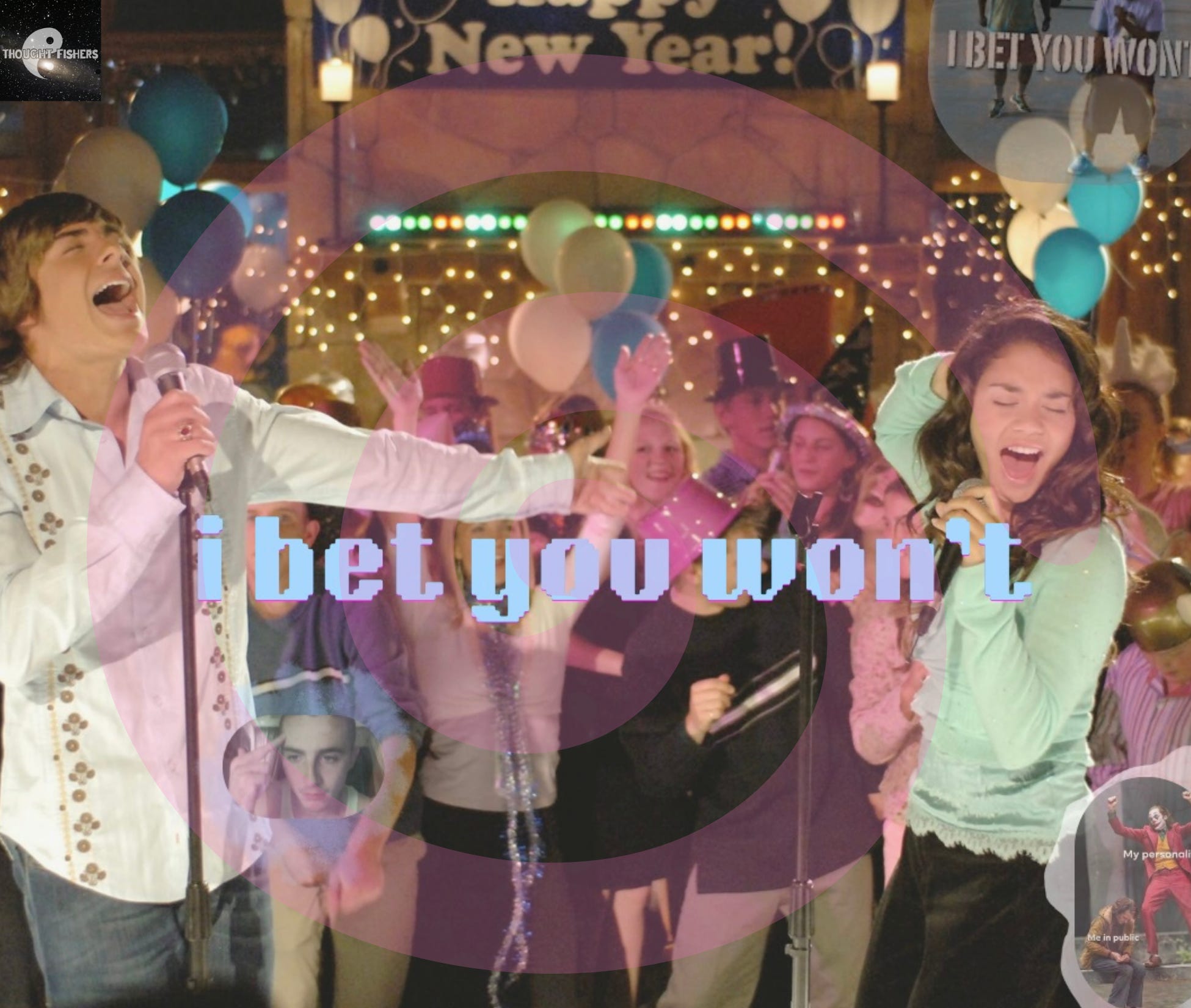
Troy and Gabriella do go up.26 First hesitantly, then shamelessly. The song choice is perfect—the verse structure mirrors the transformation: living in your bubble (your perception) → forced to take a risk → your reality expands. From “my own world” to “something new.”
“Livin’ in my own world, Didn’t understand
That anything can happen, When you take a chance
I never believed in, What I couldn’t see
I never opened my heart, oh! To all the possibilities, ooh-ooh”
- Start of Something New: Drew Seeley, Matthew Gerrad, Vanessa Hudgens, Zac Efron
The karaoke host gave them an opportunity to be seen in new images as—singer, performer—which challenged the fixed images society had assigned them prior. The song choice isn’t a generic pop song to dress the scene. It delivers the message coherently. Society gives us the opportunity to create ourselves from those images.
Their categories looked insurmountable. They were going to stay in their split worlds until the spotlight 'randomly' brought them together to sing and the crowd cheered for something different—for them! That's how society used to work as a mirror: it gave us friction needed to transcend our assigned images.
I used to sing along every time. But at 21, I watched this scene with a straight face until ultra swag27 boyfriend started singing. Only then did I give myself permission.
Why did I wait for him?
As a kid, I sang freely. What taught me this?
Thinking back on every teen party I’d been to: most were mid or socially awkward. No one danced like no one was watching.28 No one sang vulnerably in front of a crowd seriously. People barely want to pick the song on aux now...
HSM shows us a world where humans still transcend their fears by taking risks together in public. That world feels very alien to me now, and I miss it.
Wake up, and choose shame(the cost) until you can be shameless(the benefit).29
After they sing, everything returns to normal: phone numbers exchanged, typical small talk, they leave. Then coincidence puts them in the same class. Troy hesitates to tell his friends about the true highlight of his winter break. He even rejects himself, telling Gabriella the guy she sang with “isn’t really him.” Gabriella wants to tell her new friend Taylor about this side of Troy, but Taylor shuts her down given what Troy symbolizes and “promotes”.
Suppression is how the status quo keeps you silent. If you can’t talk about your real interests fearlessly with your friends, your friends become your judge, and you become the censor of your soul. Tribes demand sacrifice: performing a character instead of living your life, piece by piece, paid for with your tribe’s approval.
Society is the first mirror we see ourselves in, take a chance and look, but don’t be fooled by what you see.

I’ve lived this.
◑ übë & the Clay Factory
“Half the Truth is often a great Lie.”
– Benjamin Franklin
We’re all born into the world as balls of clay. We’re soft, warm, becoming. Clay babies, caught in an involuntary cycle of becoming until our end.
The world you’re born into looks different depending on where you are from—different economy, language, art, government—but they all have the same factory rooms: identity, family, schools, groups, and nation.
Everyone’s clay is soft in their early years. You can press your thumb into it and watch it yield into different shapes magically. Even a decade later, you can check — still warm underneath. Alive.
The factory doesn’t like this. Soft things are hard to stack, hard to ship, and hard to sell. The factory needs you hardened. Fast and optimized. But not broken, so be careful. It needs your consent while in return making you fragile.
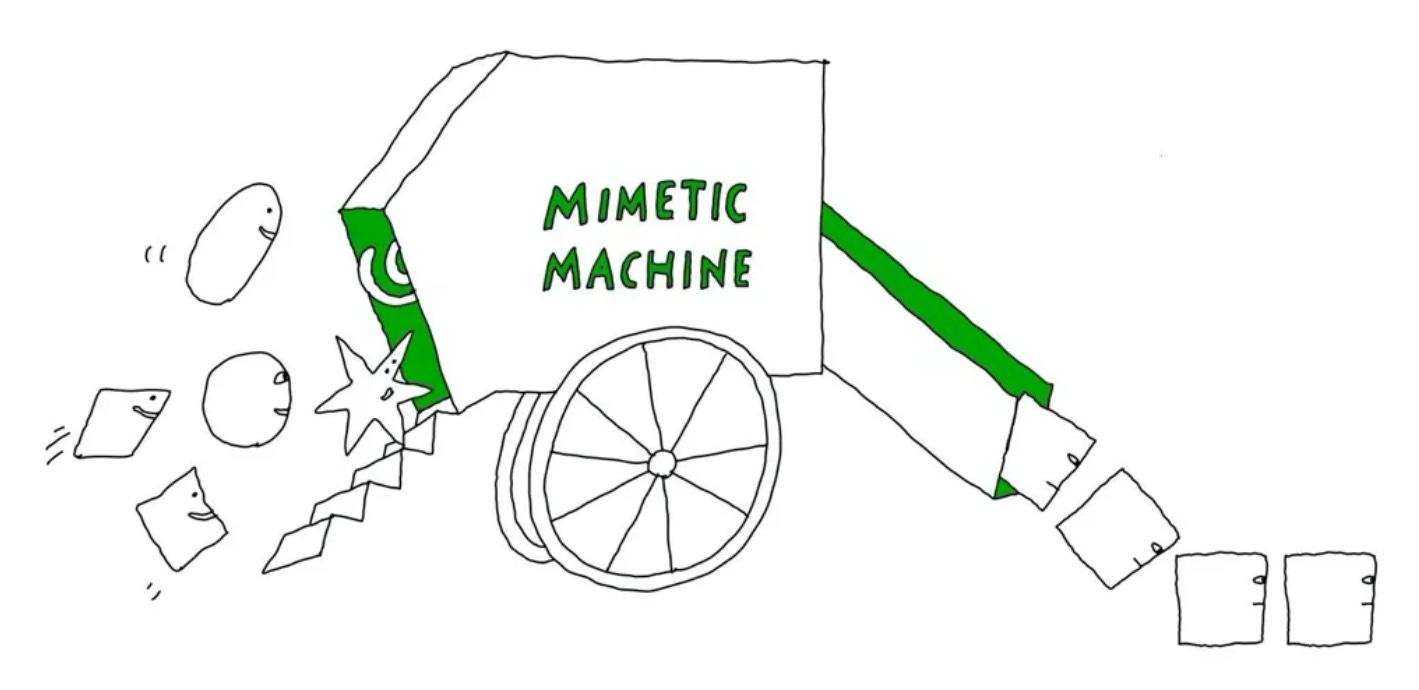
It teaches the clay babies while they’re still warm: Dream. You can be anything. Then, year by year, introduces the molds...
Factory says: Finding a shape where you belong is freedom. This is the goal.
Factory says: Your one true shape is how we see you—your color, your body, your voice, your questions, and future.
As a result, some shapes appear more valuable than others. Some are exiled and bullied for not fitting the geometry.
Fearful of being cast out, irregulars. This fear runs deep. So deep. Too deep.
Most clay babies either harden fast to find a shape that fits fine, break the rules, or give up, and take what little they can get. They shake hands and smile at the promise of belonging—faking it until their end.
One little clay baby, übë, tried her very best to find a shape. She didn’t want to be left behind. She didn’t want to be invisible. She wanted company, the warmth of other shapes pressed close, the vibrant sound of laughter she could join without asking permission first. So she pressed herself into the molds her roots told her were hers to take. At home, they all fit just fine. Felt perfect, maybe. She could dance, fly, sparkle, and shine. She sure was divine, defying gravity, and all time.
Then.
she fell...
was Pushed.
kept on the ground…
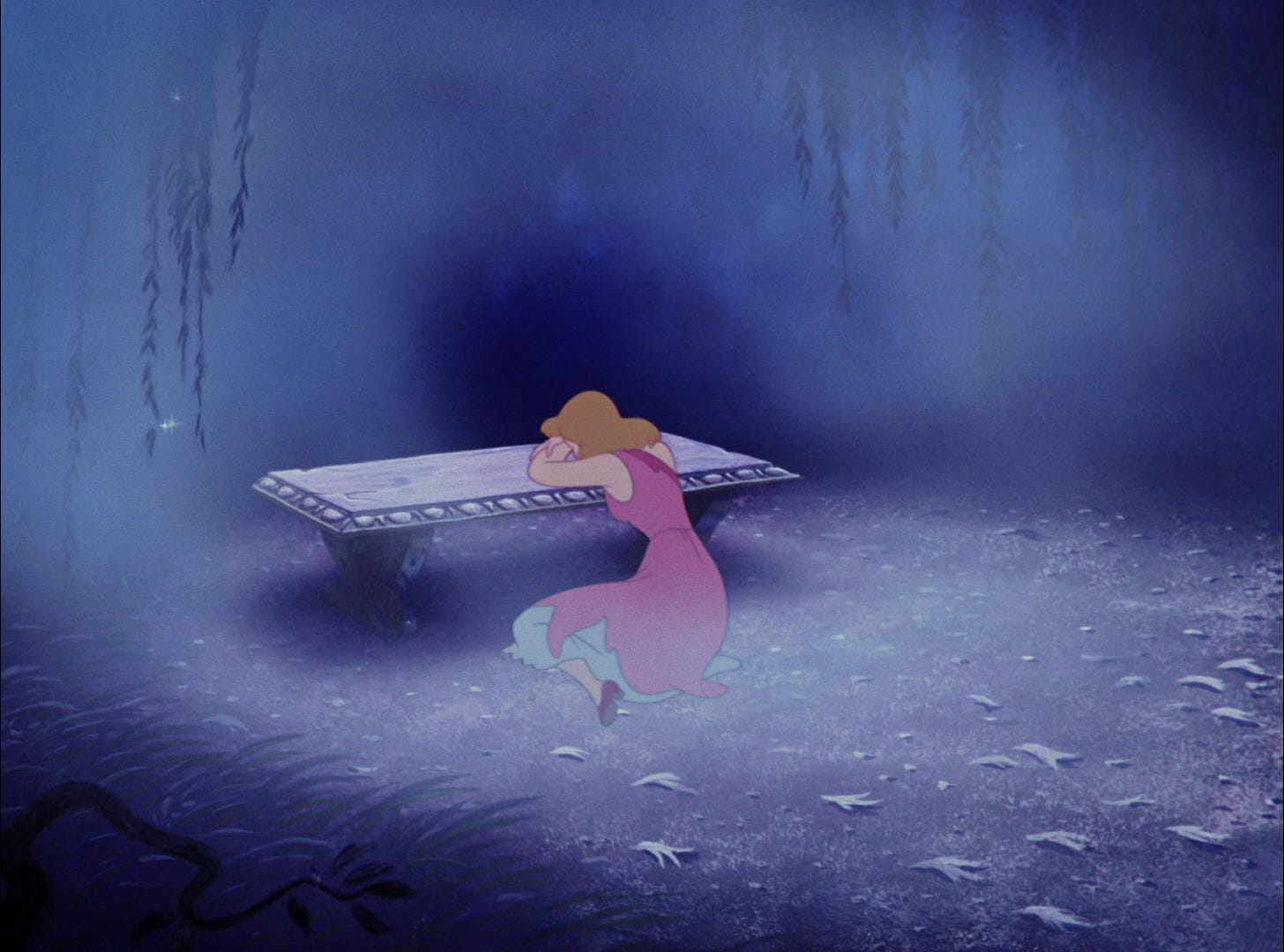
It hurt her. It muted her sound, got stuck on her shell, in her eye, burning her edges, erasing her dots, sharpening her lines. And on the inside… she grew confused…That mold couldn’t have been right, especially when the other shapes were saying it was so wrong for her.
The longer she stayed in the factory, the worse it became.
She desperately tried to mold her clay fast to stop the pain of the process—and it began to mold her. Her neighbors would always say what was right for her. With new shapes in her environment, came new molds. Then another. And another.
True chameleon she became.
Each mold she collected turned her into a spotlight. The shapes watched her light everywhere she went. They felt a warmth, and saw something familiar,
“Do you see that-
what isss that.”
She couldn’t escape it, like Rudolph, useful only for how strange she glowed with such ugly violet face.
She needed to find a shape asap. When it hurt, she stayed still.
Breathe in. Beauty is pain. Keep it in, they said.
The burn in her nostrils. The ache in her eyes from daily 8-4 shifts at the Clay Factory. When it scraped parts of her off, she grew suspicious…when she sat alone each day, shapes walked by and applauded her growing up. Though she saw the cracks, her light grew dimmer day by day. Her temperature dropped by degree, year by year.
She couldn’t be strong anymore. Her roots taught her a lesson that’d helped mold her: Pain is required to fit into a shape. The world will tell you when it’s enough—when they accept you.
the Factory then they asked her to sand down her brain. Thinking was causing her pain, she knew. Her eye was enlightening her brain. She realized they’d been training her for this all along—every day at the Clay Factory, small sacrifices, small inconveniences, small pieces of herself handed over in exchange for belonging in their geometry.
All to maintain the Factory for producing more molds.
just a means to an end…
that’s all she was—
She took the sander, hesitantly; in exchange for gold stars, belonging, and praise. It hurts less to surrender than be alone forever, she told herself.
With fear flowing as source in the abyss of her wokeness. She had hope in the sky of possibly within the boundary. Gold Stars sing the most beautiful songs. They are center of their solar system (on paper), burning bright, pulling everything into orbit. But becoming one means having five edges pulled out, one by one. It means being burned crisp, blown hollow, painted, then exploded—reborn. Not everyone survives it, but the Gold Star sticker you earned?
Sure seems worth it to be seen by all.
Little übë believed she could do it all because all had already been done to her. She’d been bleached, burnt, trimmed, sanded—and yet she still shined brighter than the sun. Some shapes paid for the Gold Star mold, but she did it naturally—she’d been one from birth, glowing on the inside, invisible on the outside. Her vivid soul wasn’t enough proof because her warmth, and light didn’t shine like the models. So the Gold Stars turned her away. She knew who she was inside, but it didn’t matter.
So when they called her mold, Hexagon, she didn’t correct them. She rose, smiled big and shined crooked red.
Here I am, Hexagon.
She quickly crunched herself into the Hexagon mold. When she pretended to like the shape they saw her as, the shapes stopped pushing her around. They called this a success. They said they found a place where she belongs—be happy.
She looked at the other Hexagons. She saw them happy outside, and crying inside their reserves each night. Sharp to the squares, smitten with the circles, in conformity with other hexagons—yet still hollow to their core. She asked round to see if anyone would try a different mold, and they all said yes. They could never. They don’t care what more is inside themselves. They are fine with how the world sees them, Hexagon. Hexagon, and what more? She was still lonely inside in their midst. Even surrounded by Hexagons who looked just like her, they just didn’t get it.
But did she get it?
She thought about her time in isolation, and discovered a simple idea: All shapes were made of the same substance. There was a time they all looked the same—warm clay. And there’s a time coming when they’ll all look the same again—dust in the end.
She knew she could transform. Dark as black empty space or bright as the sun. An acute triangle or serious rectangle. Slim as a sharp line or deep as a cylinder. with Trapezoids she had all the fun. and Ovals were the wisest in the geometry. She wanted to be with all the shape groups, not just one.
She was getting bored as a Hexagon.
Imagining being outside her mold, she missed the feeling of her own hands pressed into her clay. She couldn’t morph her clay into the shapes she wanted. She missed deciding where she curved, where she stayed sharp, where she let herself crack open.
She missed the fun of becoming.
Molding yourself, the factory taught her, was taboo and dangerous. The risk of creation? Not fitting in anywhere. Why struggle with your imagination to shape yourself, they said, when the factory can give you a mold at a decent price and tell you who you are? The factory can guarantee your future, if you just consent to it.
So she stayed in the Hexagon mold. She crouched small, safe, and surveilled. But in that abyss of fear—of not being seen for real, not being able to share what was true—she remembered that idea she’d felt once before in loneliness, long ago, when her clay was still warm: irregular shapes are still shapes.
The fear of not becoming a shape was always a lie.
She was a shape from the beginning. Freedom wasn’t just escaping the Clay factory. Freedom is remembering that all clay naturally has the ingredients to shape itself. All shapes are made of the same substance. The only difference is the mold you choose to let arrange you.
Are you afraid of your own hands?
If so, there goes your freedom...
◕ End of the Categorical World.
We’re meeting each other for the first time. Hi there.
If you’re looking at me through a categorical lens, your eyes might inform you first that I am a Black woman. Maybe next you may guess that I am American because I dress kinda Free30. But Eastcoast or Westcoast? Religion? Waffles or pancakes? Drake or Kendrick? No way you could honestly answer me with your eyes.
That’s recognition—when you see the surface, apply categories you know, and stop looking. It seems to be a bit of an inaccurate process, but in our mechanistic civilization a lot of systems look at people that way—including corporations, computers, algorithms, government, and media.
While role-playing HSM at recess in elementary, I remember allowing my character decisions to be made for me: "You have to play Taylor. She's Black like you."
What they missed and what I never shared was that: I did’t really care for coding or for chemistry. Based on hobby, I didn’t feel like I was Taylor.31 All I knew about her background is that we shared a skin color. I loved fantasy and sci-fi. To dance. I wanted to sing ‘the main songs’. But I looked down at my skin and Taylor’s skin, and what could I dispute? The “obvious fact” always won.
But truly, I never spoke up because I was scared to be the alien. I didn’t yet see:
“I’M the alien worth exploring. Things on MY planet are extremely foreign and otherworldly.” - Sherry Ning
When I was upset about being “forced” to play Taylor, I was completely missing the point and reducing Monique Coleman’s craft...32 Every single character sang and danced, by that same logic I should have related to every actor on scene…The movie wasn’t explicitly teaching me to BE any certain category of character and mesh myself.33 It was teaching me to discover who I am beyond any category, and protect that dream at all costs.
But I treated the characters and their persons like merchandise—literal dolls to collect and bargain for status in my social circle, not humans with any depth.34 There could have been a lot of other things Taylor and I had in common (religion, family, lifestyle) that made me apt to play her role—I just wasn't curious about seeing more from her because of my ego.35 I was reinforcing a factory mold of “the Black” on a character that wasn’t even written to be one in the first place…36
My truth was that I wanted to be the main character. But perhaps the people who reduced me to a color wanted to be main character’s too.
Perception is the tool we all needed to think more reasonably. Perception means you apply a scoped lens that helps you look closer—then upon relation you keep looking for peculiarities, and differences, at the unique person standing in front of you. You stay curious and open.
The categorical world makes us confuse these two ideas. We treat recognition as knowledge, and mistake inference for understanding. Society can’t Control individuals who can’t be fully known from sight alone.37
“

I believed I could be anything, but the world soon taught me otherwise. Men38 convinced me of who I was and what I could be. Our illusory authorities. The meditation that keeps me sane at each injustice: if men don't get their rights from God, they get them from other men. Teachers, parents, friends, and now strangers on the internet. All saying the same things in slightly different words: You are what we see. Act accordingly.
Navigating that paradox was draining me. I stopped believing in possibility. That collapse turned into anxiety—fear of man, of judgment, of being perceived39. When I accepted that my rights come from my nature, not from other people’s approval, I resolved that conflict within myself, and invited my light back inside me.
This was the work of the factory, but how did the factory get its power in the first place?
¿De dónde proviene la categoría?
“to begin to study it, study the nature of preconceptual thought, you might go back to the pre-Socratics, or preliterate thinkers, and see how they encountered their world. But we are post-literate and more primitive than the pre-Socratics ever dreamed of being.”
- Marshall McLuhan, Garbage Apocalypse (1970)
these are approximations
2 million years ago: Humans began organizing in tribes. Categories emerged from survival: kin vs. stranger, elder vs. child, prey vs. predator, hunter vs. gatherer. Pattern recognition and listening to their senses kept them alive.
2,000 years ago: Greek philosophers formalized categories with intuition and reason. It largely gave us the foundation of believing there is a truth to pursue. Before the ancient Greeks, oral and image based communication of the past had more fluid and amorphic understandings of nature.
1, 000 years ago: Discipline societies came and enforced those categories through domination and control of individuals. Feudal systems locked people into birth castes. The Church sorted souls into the saved and damned. Monarchies ruled the world. The transatlantic slave trade justified brutal legal genocide. Categories weren't just philosophical ideas—they became law, backed by wealth, surveillance, infrastructure, and power over another humans life and death.
200 years ago: You thought you were a Free man working-man? The Industrial Revolution mechanized categories at scale while chattel slavery continued for enslaved people in America.40 Factories turned free people into interchangeable workers to scale nations. People as property are the ultimate mechanization of categorization. Mass production requires mass sorting.
20 years ago: The factory went digital. The molds transformed into code. You’re not even managed as a person digitally even if you wanted to be. But were you ever? As a means to an end for any and every institution, there’s so many of you now they can’t keep up.41
Today: We're living in the final form of control. We will continue their legacy, a new horizon, or DOOM our children? …Time will tell.

Before categories, there was chaos. The Pre-Socratics lived it: Heraclitus said everything flows—you can’t step in the same river twice. Reality is constant change(flux). Plato realized he couldn’t control any of this. They lived in percepts—immediately sensing42.
If they were right, and reality is pure flux—then nothing could be known. If Protagoras is right and, “man is the measure of all things,” then truth is subjective, damn near impossible to reach, and the state could collapse. So Plato invented a Theory of Forms43 where everything participates in an eternal, unchanging state. You can’t really know something unless you can identify which eternal Form it belongs to. That form is it’s truth.
This was genius for organizing abstract ideas. Fundamental even. Mathematics, logic, and geometry are all somewhat rooted in or inspired by Platonic thinking. If there's a perfect Form of "Triangle," then we can reason about all triangles without measuring each one. Unfortunately, for sorting humans so they self-actualize? A nightmare in consequence44, as human bodies are material(part of the physical world), yet also “the person” cannot (yet) be investigated by physics. Our ‘personality’ is an abstract, particular set of ideas.
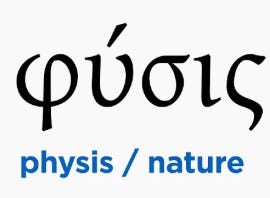
McLuhan explains:
“the Greeks abstracted phusis as a visual figure from the seed of surrounding 'barbaric cultures.' Thanks to the art of writing, the Greeks were able to establish a new order of conceptualized and classified structures which gradually became consolidated as the new Nature."
Philosophical literacy gave categories their permanence. You can’t fix people into stable categories in an oral culture. Writing enabled institutions to formalize people as categories. The first writers fell in love with abstracting truth. But that drive ignored the complex reality of how all humans actually lived. It left us an incomplete history, which means we have half the truth to work with.
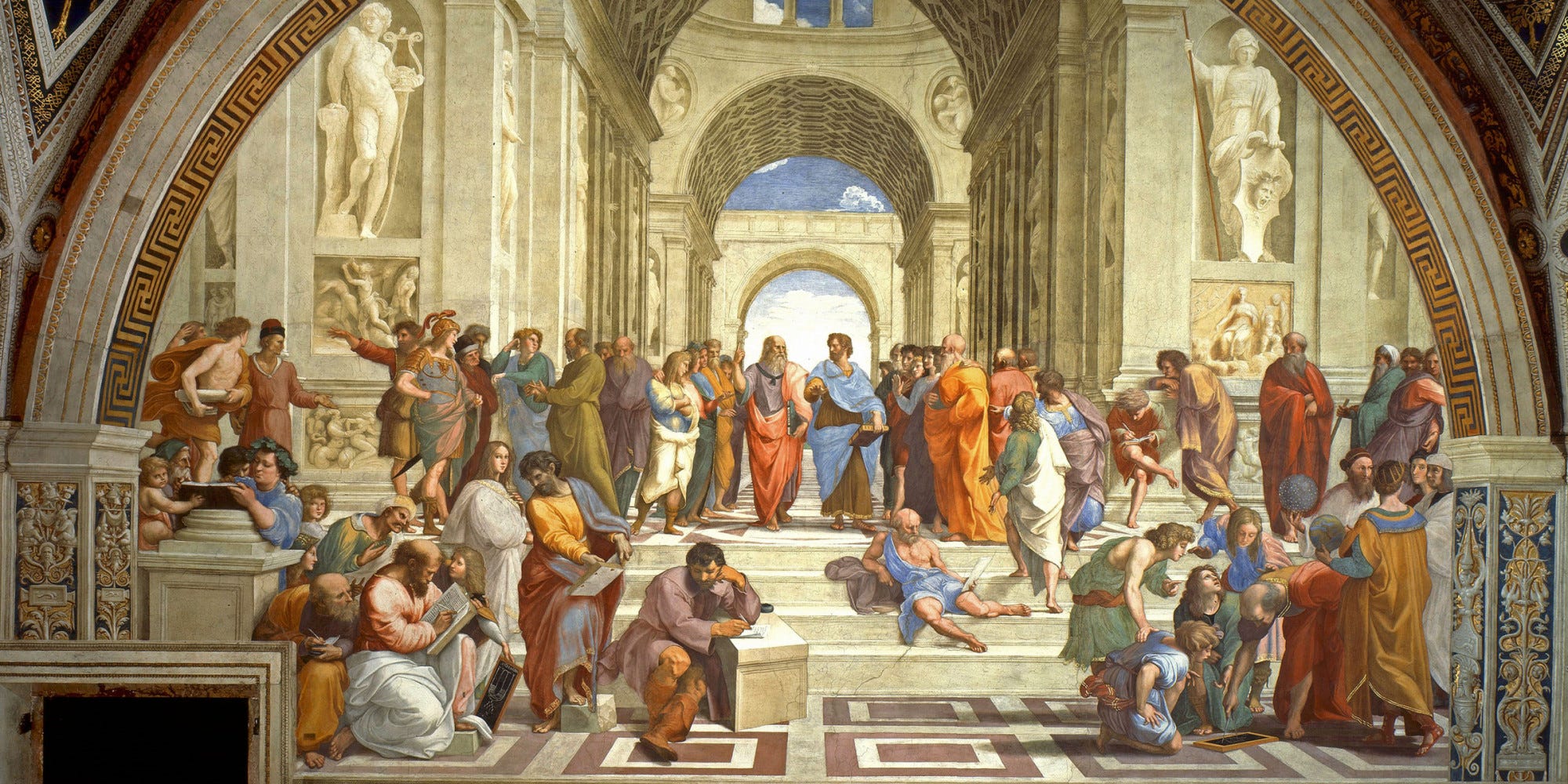
While rejecting Plato’s abstract Forms, Aristole played and ran with the idea of creating the Categories to organize all of reality. Down the traditional philosophical domino line, Aristotle is the trigger out of pure sense and into rational thought. While the formalization of categories was a revolutionary tool for organizing human information and sense into knowledge, it has evolved into a rigid infrastructure for social control.
Aristotle’s Categories established a systematic way to classify entities and their properties: the vocab and framework for logic, the syllogism, and distinctions. It became the very first comprehensive system for organizing knowledge, grounding inquiry in empirical observation, and extracting truth from abstraction. Almost every thinker since has referenced Aristotle’s work in some way.
That is the power of philosophy.
And also it’s weakness.
The truth feels safe, once you know it.
Is anyone to blame?
I know it feels good to cast a villain45, having someone to blame is a lot less work than searching for the answers to their questions. But the West didn’t do this work alone. Different cultures across human existence have used their own “philosophical frameworks” to “sort” people and knowledge. South Asian philosophies reinforced caste systems and totalitarian marriage laws.46 East Asian philosophies built rigid hierarchies and authoritarian customs.47 African philosophies did all and also circumscribed self-actualization through age grades and lineage systems.48 For sake of collective, every civilization sorted people—by clan, tribe, birth, caste, karma.
The tragedy isn't that “the Greeks” formally invented these categories in philosophical writing—it's that we inherited this framework without truthfully investigating it in good faith, both for their fruits and their thorns. The tragedy is never the human invention, rather unquestioned inheritance. We built interpretation upon interpretation for thousands of years. The tools for understanding ultimately morph into tools for controlling people in the wrong hands. Our entire society now rests on ancient philosophical texts from thousands of years ago.
I hate to say ____ ______.
We would’ve been ****** in 2020 or 2023, but we ended up using AI for ex-president fart videos. Soo…Odor in the court? We have more time. I wish this was made with AI… How are we even alive still?
Exploitation occurs when power realizes the light philosophy shines on humanity. Knowledge is power but with love it becomes freedom.
McLuhan saw what we lost:
"It is play rather than connection or logic that makes possible both wheel and axle. Logic is known only to the visual man who looks for connections rather than for play and metamorphosis."
That’s all: play and metamorphosis.
Pre-literate cultures lived in play. Greek philosophers arguably still played.49 And anyone else before the 20th century get’s a pass to have played with their thoughts too without the breadth of science and history we are burdened with in the 21st century.
What makes the West distinct was it’s scale and export, but here’s what they couldn’t see in hindsight: institutions need categories to measure the abstract. They can’t afford the play and sensation that we can compute naturally as humans. Which is why the goal of power and Control is to make everything mechanistic and legible…
Now damn. Mechanistic and legible… sounds like calculator nation. Calculator nation is how I felt in the 2nd grade when I personally diagnosed myself as “BAM”… Twas a sad day for my STEM self-image, but I realized that day that teachers were trying to turn students into calculators. It was a waste of my brain power to do math my calculator could do... or so I thought, bless her… no really, math is life!!
The need to divorce from all of this is understandable. Seriously, none of us consented to any of this. You have your people. At least enough of us do for all of us to be bystanders of our dying planet... Abolition and partitioning into tribes always seems like the best solution.50 Unfortunately, dominant postmodernism and science have been trapped in the privilege of play without purpose and goals for decades now. Some departments are failing students.
“Where is the wise person? Where is the scribe? Where is the debater of this age? Has God not made wisdom of the word foolish? … To those who are called, Jews and Greeks alike, Christ the power of God, and the wisdom of God.”
- Paul the Apostle
We have the science, the theories, the questions, and we have the many centuries of history to reflect on. Most importantly, we have the evidence to create knowledge.
So let’s put our ‘big boi pants’51 on, and do some real math(with our heart and minds).
Instead of inventing new ideas that shape the world and move our horizons forward. Why do we spend our time shaming or idolizing our human ancestors for their context instead of answering their questions best we can?
“It should be remarked in primitive societies creativity, originality, and novelty are not appreciated, rather doing as one’s ancestors did is the proper thing to do. This is also true in many large organizations today; the elders are sure they know how the future should be handled and the younger members of the tribe when they do things differently are not appreciated.”
- Richard Hamming, The Art of Doing Science and Engineering, pg. 176
You must not forget all who came before you. You must accept this baton to think differently and take action on those ideas in your head.
[watch the whole thing please → 60sec]
.
.
.
Back in 2011, late at night. I snuck into my parents bedroom as they were sleeping. My dad got his first Mac52, and I didn’t care about breaking the rules to play with it…
I was nervous because this loud sensory startup startled me—I was sure going to get caught. And somehow, I found my way on to Youtube where Steve Jobs woke me up in the second grade. All from an attempt at listening to music. I mimetically wanted to be apart of the crazy genius family of humans whose creations and ideas push the human race forward, and I knew I had the substance to do something real—my humanity.

from Violent → Nonviolent Institutions
Let’s look closer at this together: When we feel that 'capitalism53' isn't delivering the freedom we were promised, we might be feeling the weight of much older systems in place long before it. Long before our concept of modern markets existed, there were deep structures of discipline and control already in place. It’s worth wondering: have we ever truly experienced a free market54 economy, or have we simply inherited ancient ideals masked by constraints that make true individual freedom and collective benefit impossible to reach—not just because of corruption, but because of our basic organization of human life for centuries?
From Foucault, I know that discipline societies are institutions that shape you through surveillance and enclosed spaces, like zoos but deadlier and more humiliating. Discipline societies evolved into control societies which is why the systems have not changed: prisons, education, science, hospitals, government, etc. this what we can fix together right now55.
In control societies, you’re not managed as a person. You’re made into ‘dividuals’—fragments of data that can be mixed, matched, and sold like Lego bricks; because dividuals are more profitable than individuals. The goal of machines are to maximize dividuals, and work with a few individuals to Control the rest.
For efficiency, they practice separate “but equal” selves. You are not one person moving between worlds, but many parts fragmented and unified at the will of the algorithm and power. Unfortunately for us, our fragments aren’t unified or willed at our own command.
Make America Free Again.
I am writing to you as Ms. Philoso-Free56 skipping my free university class to speak to you right now. Why?
In the old system, you were put into molds. In the new system, you have to choose active becoming. That’s why I’m spending my MLK holiday writing this lol.57
“I don’t believe in isms, I just believe in me.”
- As Ferris Bueller once famously said58
Think about it. If you don’t choose to be some accepted image, society will choose an image for you. Police don’t need to police the individual when your classmates and parents will do it for free. The factory doesn’t need physical walls when the molds are in your mind.
Every high school senior learns this the hard way: you can graduate high school with people you think you know. You never graduate from a being reduced to a category.
Poor Ferris…
It is not what category you belong to, but more interestingly what your soul desires to fill its set with.
I’m wondering if our eternal form is our person, human. As a person you're opaque and still particular. It is every persons shared origin as human. A person’s soul can be represented as a set of information that steers the psyche, which emerges a fundamentally unknowable horizon of ideas and senses. You can listen to the chaos of your mind, and make sense of it with reason.
Every human is chaos.
Disorder is meant to be ordered, that’s how we transcend and move forward. I’m no physicist, but Feynman showed me how entropy is what lets us perceive the flow of time. Which revealed what we need in order to build our futures. He says in this lecture that the laws of physics do not have obvious direct relevance to abstract human experience in varying degrees.59
The way you expose yourself to high levels of randomness is through exploration and discovery. You must disorder yourself first to put yourself in any order for the world. If there is a such thing.
● Our Right to Øpacity
Our right to øpacity offers that we embrace our fundamental unknowability, when we resist being made legible to others, we then create the randomness needed ‘to order’ (discover) all we are. Øpacity doesn’t fragment our many parts of our humanity, but rather creates a coherent umbrella for all to live within. No person, yet, can be left outside of the human boundary. We, as humans, can belong everywhere or nowhere in relation, instead of only in rooted identities.
ALL world, for ALL people of Earth:
Eugene: “It’s not about removing the richness of language or culture, it’s about reorienting our borders around things that aren’t violent. The current issue is that culture and language is reinforcing a kind of violent border that excludes and restricts people. The purpose of a border should be to appreciate the flavor of one place from the other. It should remind us of the beauty of nuance, the richness of the world.”
Reggie: “it should be a new sensor, not a dividing line.”
Eugene: “We need to rethink borders as a tool for economic exclusion… by thinking of these things in the forms of images and ideas that we can make, produce, and mock up—we think, what if we just brought that here… or applied this here? We then get the by-products we’re talking about.”
- Eugene Angelo & Reggie James: This Could Still Be A Movement60
Our humanity is the essence that matters most. We’re born. We live. We create. Then we die. Everything we identify with along the way is negotiable. What you call your identity is simply a framework we built to manage chaos.
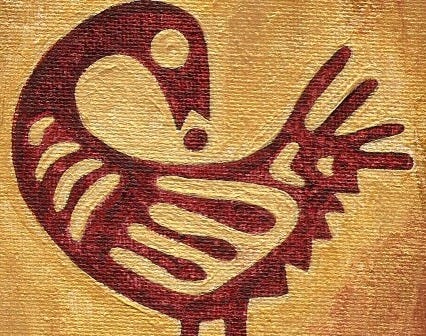
It's not wrong to go back for what you forgot.61 So always go back for yourself.
Stop trying to control your chaos. It’s circular, so Surrender to it.
Time for evolution 🌀
This is where the great, Édouard Glissant62 becomes essential for our human evolution. He distinguishes between two kinds of identity: filiation and relation. I’m going to call them roots and relation. Roots is determined by genetics and environment, relation can be by choice. Identity is the key aspect to scope when investigating human persons.
Roots says “you are what you come from”, and C. Thi Nguyen would say this makes recognition feel like true knowledge to those who don’t examine. Your roots, background, your categories are you. The root, Glissant writes in Poetics of Relation, is “unique, a stock taking all upon itself and killing all around it.” This means the category wants to dominate and exclude anything that isn’t it, this is the violent border Eugene spoke of.
Your ‘jock-ness’ must come from your ‘jock roots’—an athletic build. Your ‘achiever-ness’ from your ‘achiever roots’—aka successful parents or lack there of. Most people stay where their roots are planted. The roots trigger fear to all who threaten its’ boundaries.
Relation is what we’re looking for… it says you are what you encounter (C.Thi’s perception). Your identity is a network of roots spreading sideways, connecting, becoming. Troy and Gabriella randomly stumble into each other at that teen party. They don’t discover who they ARE (a fixed present state) in the moment. They discover what they can BECOME together in the moment. That is what made it the moment for all.
Here’s where things get violent for the category world non-violently;)
Things opaque can’t be seen on the surface, this works for humans because our essence lives deep within us. The Control society now wielding “Western philosophy”63 as its weapon can’t tolerate any øpacity. If they can’t fully understand you, they either try to make you legible (assimilation) or get rid of you (annihilation64).
We then adapt from factory models: To know you, I must make you legible. To relate to you, I must reduce you to something I understand.
How to use your right?
Don’t remain silent. Øpacity doesn’t mean you should just mask yourself forever. Øpacity is your right to control what the world knows about you. The freedom to choose. Choosing what you reveal, when, where, and to whom. Choosing to stay unknowable where categories would make parts of you that don’t fit their equation disappear. This is to give you the space to be honest and discover yourself. Øpacity is efficiency for your soul.
You can’t attend to everything, a reason why the human body is such a brilliant system is its storage and energy conservation. Øpacity lets you save energy through your refusing to perform legibility.
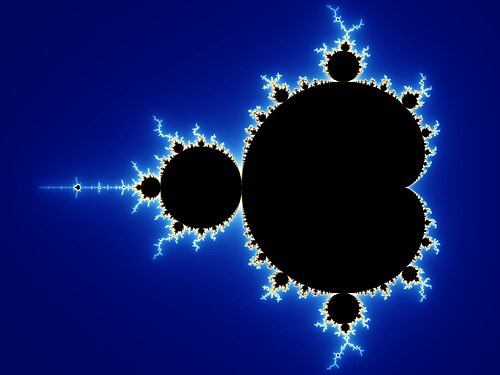
Reality has a surprising amount of detail to quote John Salvatier65. When you get close up to anything, the details multiply endlessly. However, creating yourself and reacting to the world around you will always matter.
People will try and save energy in either reality. Øpacity protects your privacy to examine yourself. Even if, øpacity for you, might make you look basic to the world. Be basic, then. Being "basic" used to be an insult, but based on the way Nadia Asparouhova layed it out...66 I want to argue it is already become a status symbol.
Still, I find “basic” to be a helpful way reframe life with øpacity. She describes being basic as a way to signal you're not toiling, not constantly externalizing every thought, not performing depth for an audience. She opens up that sometimes you need years to articulate what you're thinking. Based on the fact that I’m 21, finally thinking deeper on all of my childhood ideas on this subject—it feels true in lots of ways.
Sit in unclarity and think about it, learn to reason and feel it all raw. Write through it, sing through it, dance it away. Paint about, theorize it, debate it, research it, film, refute it all, and get to know it up close. Take it apart. Then build it. Invent something. Be wrong about it, hell be the most correct on the subject matter. Whatever it is, it belongs to you—if you’re willing to take the risk and give a little bit.
If you’re still reading this, you’ve probably been in that factory before too. You probably know the moment; you were there, you know the history, and you have the tools.
In your øpacity, play anyways (you like). The only requirements to play freely is your humanity and ability to know what game you’re playing.
Even abstaining from the game is ‘a play’ unfortunately. Life is a game where you will sow and reap— regardless of action or inaction. I know being here is random and unfair, but on this Earth, as humans, we have work to do.
Øpacity only gives you self-control only over WHICH details matter to share, which parts of yourself to cultivate, which to keep private, and what to kill. Categories must reduce you to data to measure and predict you. But your nature is highly nonlinear and highly variable—hard to measure. That’s why the categories hurt US.
“Before you’ve noticed important details they are, of course, basically invisible... This means it’s really easy to get stuck. Stuck in your current way of seeing.”
- Salvatier writes, Reality has a surprising amount of detail
The parts of us our categories erased are the details we ignore—whole sides of us that don’t exist in the categorical world.
“you might think ‘So what?…I can just notice the details as I run into them; no need to think specifically about this’…if you are doing things that are relatively simple, things that humanity has been doing for a long time, this is often true. But if you’re trying to do difficult things, things which are not known to be possible, it is not true.”
- Salvatier again, same piece
As people of Earth we embark on a difficult mission, and as Salvatier teaches, the more difficult the mission, the more critical details needed to understand. If you wish to succeed on this mission, seek to perceive what you have not yet perceived. Øpacity isn’t hiding, it’s choosing to be known through encounter, and relation.
Choose to reveal yourself on your own terms. We, humans, can belong everywhere in relation, instead of only in our rooted identities.
This can be the end, if you decide to go on your own journey. We’ve created AI (all of our dividualized data), we’re having to make synthetic data so the machines can keep up, things are getting complicated, we could lose our Earth, potentially the freedom and humanity of our descendants.
Now what?
Knowing where it came from doesn’t explain how control keeps its power. For that, we need to listen to fear.
The Audition
exposing the fraud of “earned identity”
The audition scene is the heart of the entire movie because it reveals something deeply offensive to the status quo: trained performance can’t compete with vivid soul.
Sharpay and Ryan are very polished. Well oiled. Optimized and precise. In-sync choreography, beautiful costumes, perfect harmony, perfect timing, perfect branding. And yet—it’s mediocre.
Why is that?
It’s performance without any real risk or depth.68 The teacher rejects Troy and Gabriella for being too late. But then she hears them singing at the piano. They’re untrained singers. They don’t know the blocking. They’ve never done theater before. And yet the role is perfect for them—because it feels true.
It’s irrational in the best way—human. Here they aren’t ‘mathlete’ or ‘ball player’—they transcend those categories as two souls singing a song. Their peers feel soul immediately. The skater cellist. The mathlete hip-hop dancer. The basketball playing baker.
Duality is your first dip into your multiplicity. Your soul feels at home wherever you’re honest with yourself.
But honesty requires facing fear.
Fear itself is complex in nature: you can fight, freeze, or flight. Fear can trap you or you can dive through it to discover what's on the other side.
Troy and Gabriella first listened to their fear and acknowledged the elephant69 in the room. They told each other that they were scared. Then they dove into their fear anyways, together. But they arrived as individuals. Go your own way, but with all your heart. When you follow your truth, unknown friends will find you.
Fear is real, but becomes surmountable when you listen to it.70 How else do we know how to accept the opportunities that require us to give before we can take? This is the lesson HSM tried to teach us: Your soul doesn’t need to earn belonging.
Belonging lives in you and can only be discovered—when you’re brave enough to be honest with yourself.
The cafeteria scene reveals the tragedy
Every divided clique comes together—by accident or design, it doesn’t matter. The point is: they CAN unite.
it is possible…
no, no, no, no ...Nobody states the obvious that maybe it’s time to unlearn what they know. What’s funny is that they are so in sync, they’d already coming together in the most productive way. This fear of unlearning runs so deep that the decathlon nerds and basketball players are already unlearning it by teaming up and hanging out outside of class to sabotage Troy and Gabriella...Great example of how the mob misses as a collective. They’d rather hurt their “friends” , than admit they’re afraid of seeing something new.
Until you confront your fear, you’re stuck with only what you already know. And here’s the terrifying part: what if your “knowledge” isn’t even yours? What if it’s just categories someone else handed you, and you’ve been defending them your whole life? Like I said, the cafeteria scene reveals these students CAN unite. They prove it every time they sing. But the moment the music ends, fear pulls them back to their separate tables.
That’s not an accident. That’s the Control society doing its job.
I say: Life is too short to waste it living in the darkness of a lie.
So what happened?
Why didn’t we listen?
Shhh. Be still.
The violence is tempting…
Non-Violent resolution
Sharpay sabotages the callback time so Troy and Gabriella miss their audition time.71
By now the students have started accepting each other across ‘clique lines’—the jocks cheer for the nerds, the theater kids respect the athletes. But when they find out about Sharpay’s sabotage, their friends instantly want revenge... The mob acts on pure emotion, wanting to stampede because it feels good. The herd needs a leader, a bellwether to light the way.
Love is the immutable principle that makes human evolution possible.
“See that none render evil for evil unto any man; but ever follow that which is good, both among yourselves, and to all men.”
- 1 Thessalonians 5:15
Non-violence is rooted in love at all costs, which is a transcendence(disruption72) of fear. Troy lights the way and says no to revenge. He wants to work with the love they have for each other, not against it.
Yes, what follows is absurd. Everyone apparently has nothing better to do on a Friday night than hack the basketball scoreboard and smoke out the chemistry lab—all to make it to their friend’s audition. But it is exactly the kind of mischief we need back in human life. The basketball team learns how to encourage the decathlon team, and vice versa. They win their respective competitions, then come together to win the audition—late again, but united.
This is what competitiveness used to look like: playful, collaborative, aimed at lifting everyone up. The students remember that working together across illusory divisions actually works.
Don’t let the dramatics distract from the truth of the message: There’s not a star in heaven you can’t reach—if you break free and stop obeying the prison of a category. #betterTogether
◕ The Control Society
Steers with Fear
Troy is the first to notice something’s wrong. But In “Get’cha Head in the Game,” he can’t ignore it anymore:
“Why am I feeling so wrong
My head’s in the game, but my heart’s in the song
She makes this feel so right, should I go for it
Better shake this, yikes!”
- Get’cha Head In The Game: Ray Cham, Greg Wells, Drew Seeley, Zac Efron73
Jonathan Haidt has a metaphor called the elephant and the rider. The rider is your rational mind—small, logical, trying to steer. The elephant is your emotions—massive, instinctive, and ultimately fighting for control. When they’re in sync, you move forward. When they’re fighting, you either drag your body where your mind wants to go, or your emotions carry you somewhere your mind doesn’t want to be.
Western philosophy tends to separate intellect from emotion. Other traditions refuse this split.74 True philosophy isn't a binary discipline. It involves drawing wisdom from all parts of the world working together—smarter together. Human intelligence means utilizing reason and intuition. Rider alongside the elephant.
Reason, intellect, emotion, and intuition would surely explains how senses are both honest(rational) and untrustworthy(irrational) depending on how much attention you pay.
Fear is how the Control society maintains itself. When the rider and elephant are out of sync, you're easier to control. If your emotions and logic are fighting each other, you're too busy managing internal conflict to question the game.
You see this with Troy and his friends. But you also see it with Sharpay. Sharpay sees Troy looking at Gabriella. She follows Gabriella into her chemistry lab, introduces herself, then panics when she realizes Gabriella isn't just beautiful—she's brilliant too. Sharpay is fearful she can't compete with Gabriella's duality.75
Without questioning her fear, Sharpay turns it into a weapon. She tells Gabriella she needs to go back 'where she belongs.' But who decides where someone belongs? You or someone else’s fear? Sharpay thinks she does, but that's just her elephant screaming while she pulls the reins harder, forcing it into submission. That's why she dominates instead of connects.
Scale Corrupts Message
Sharpay's ignorance—choosing fear over truth—foreshadowed what would happen to the franchise itself. HSM1 didn't exist in a vacuum. Soon after came the second movie, and where HSM1 is about finding the soul through friction, HSM2 is about losing soul through scale.
Scale isn't inherently harmful to art. What's harmful is scaling without awareness—not analyzing what's working, not questioning whether the benefits outweigh the costs.
What did they scale?
Spectacle. At any cost.
Barsocchini embedded the message of transcending categories into the essence of HSM1, but his writing for HSM2, while still alive with meaning, began to get buried under glitter.
Contrast is stark: HSM1 opened with risk and play. HSM2 opens with a 4-minute ‘school’s out’ dance number where they don’t actually leave school and have fun...
It was almost an empty spectacle... Before it even premiered, everyone I knew anticipated ‘What Time Is It?’ We wanted summer, summer, summer. Watching it then felt hypnotizing. Now that the glitter is gone. The incoherence is obvious and annoying.
They lost me in the first four minutes.
◑ the Mimetic message
Barsocchini's inversion was simple: instead of writing a musical for theater kids to play and convince the other kids is cool, the popular jock guy, had the desire and opportunity to sing, like his high-school teammate. Disney found the most '“popular-jock-guy” they could, Zac Efron as Troy, to trigger a mimetic domino effect: if Troy can transcend his category, then maybe we can too.
But did that work? Did we see Troy as human, or simply a teen heartthrob who happens to dance well? I watched this movie through the lens of the Control society, trying to sort the characters into categories I’d already understood.
Glissant can tell us why: comprendre versus donner-avec.
Comprendre (to understand) literally means “to seize”—to grab hold and force it into your existing framework. This is recognition, you take what you can comprehend and ignore the rest to save energy. Donner-avec means ‘to give-with’—to approach something with generosity and curiosity, to let it exist in its complexity without demanding it fit particular categories.
We didn’t fail to understand the gist of HSM. We failed to take action on it because we tried to seize its meaning without considering how we might be reproducing the same categories the movie was trying to expose. We wanted to sort Troy and Gabriella into boxes—hot guy, smart girl, singers—instead of accepting their invitation to rethink boxes entirely. That’s why I felt the vibes but didn’t learn the message, and ended up repeating the same patterns in my own life.
Mimetic is to…
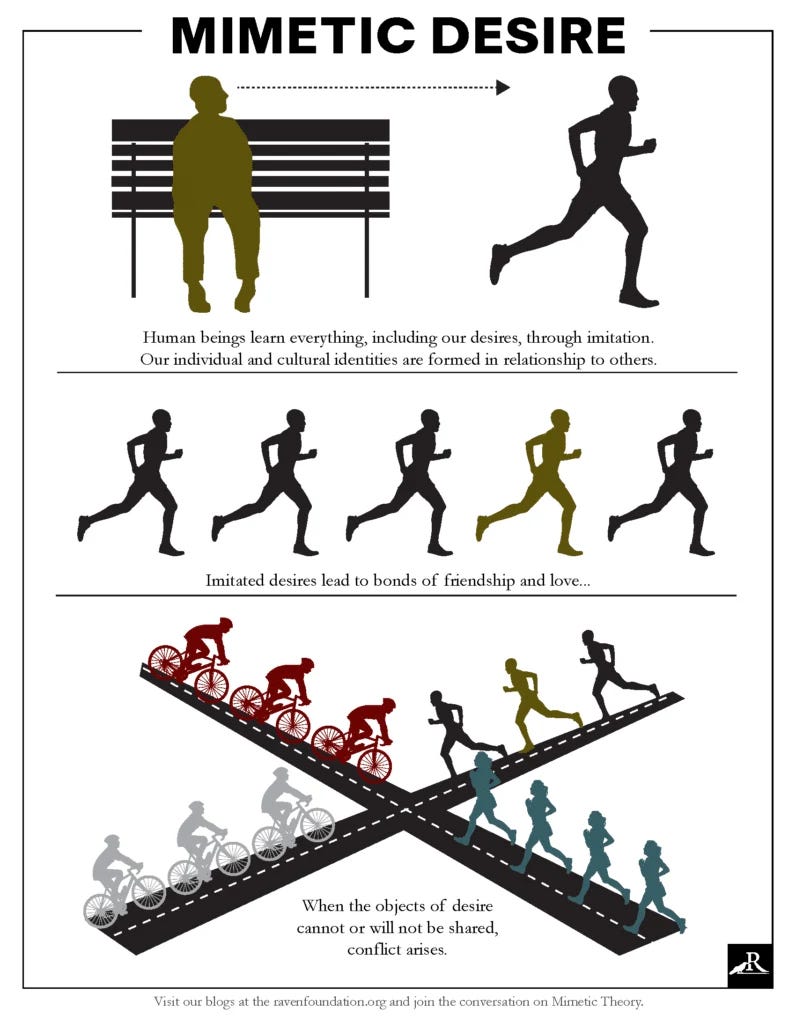
René Girard argued that all our desires are copied from models we see around us. We don’t want things because WE want them—we want them because we see someone else want them first. When two or more people copy the same desires, rivalry and conflict emerge.
“If our desire to be like a model is strong enough, we’ll want what the model has or to be who the model is. Push it far enough, and we become rivals—or with peers as we compete to imitate the same model.”
- René Girard, I See Satan Fall Like Lightning, pg.72
This is the veil of mimetic desire in action::.:..” Sharpay doesn’t want Troy as much until she sees Gabriella wanting him. That’s when he suddenly becomes all that matters.
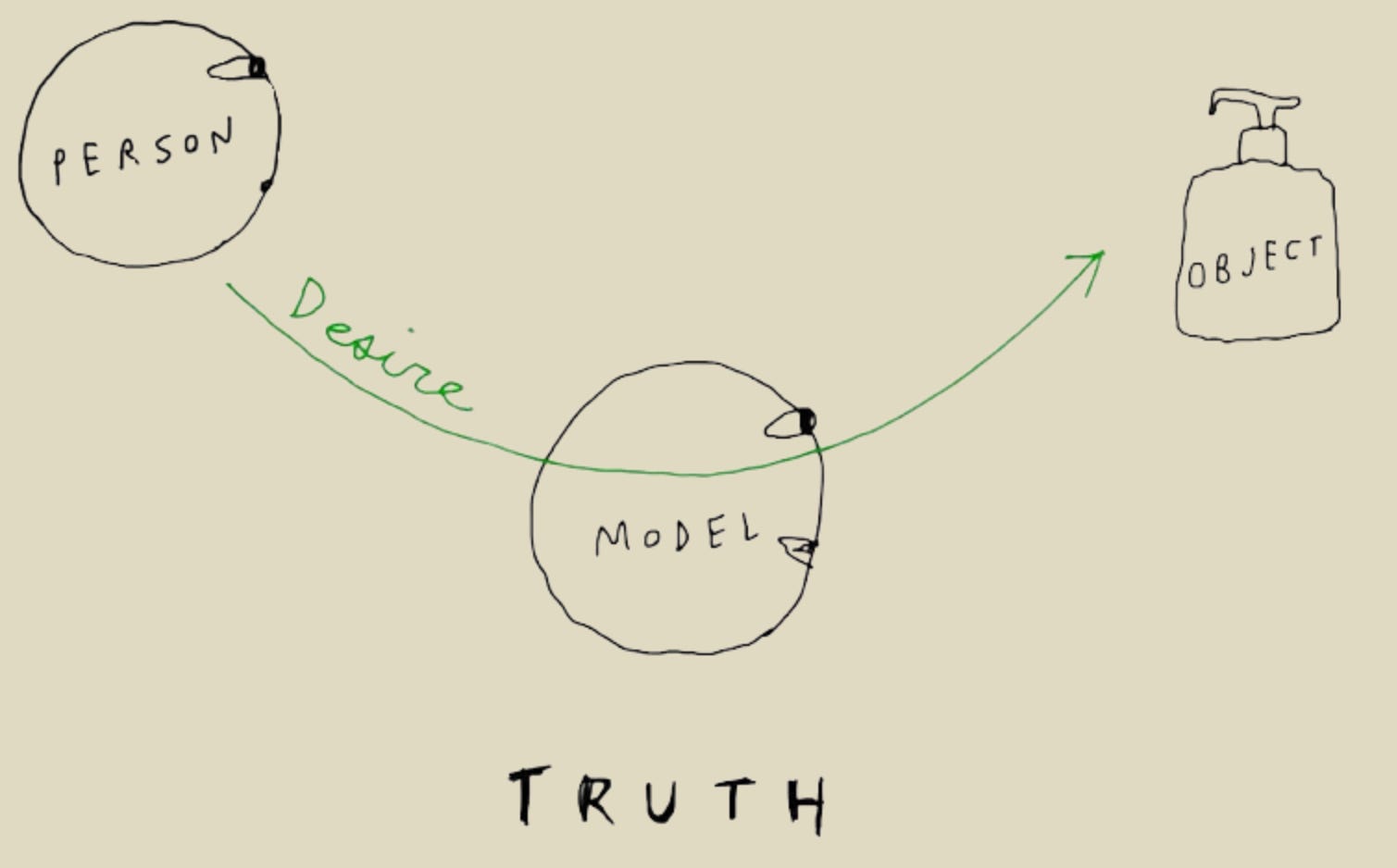
Control scales this by systematically restocking models to copy—celebrities, influencers, characters, politicians…They’re everything we’re not, which makes them irresistible. We see them and think: if I become like them, maybe I’ll be enough.
What did we copy from them?
HSM gave us its’ characters as models. Did we copy a willingness for vulnerability? Was it their courage to be real? Their ability to transcend categories?
But no, nope. We just copied more categories. Fear of being shamed and cancelled. Fear of being alienated in our communities. Fear of being honest. Bite our tongues, cheeks, and walk on egg-shells until a model gives us the permission to “be free”.
“I’m not weird for wearing these shoes, didn’t you see Stacey Steve Staples was wearing them at Bi-Lo last week…”
* she says as she saw Stacey Steve Staples do it first *
For any infectious spectacle, there needs to be a leader. Troy Bolton became the Regina George of HSM. Remember Mean Girls?
In this scene76, Janis and Cady cut holes in Regina George’s shirt to humiliate her. The next day, every girl at school showed up following her lead. They weren’t inspired by Regina’s confidence or individuality. They didn’t care why there were holes in her shirt. They just saw her, and wanted to be her.
Troy exists in the same realm, guys want to be Troy. Most didn't mimic him to copy his courage or vulnerability. The mass recognized his looks and popularity, even if they particularly valued more. Like the girls with Regina, they captured Troy's score over his message.
I call this the ReGeo Pokémon effect:
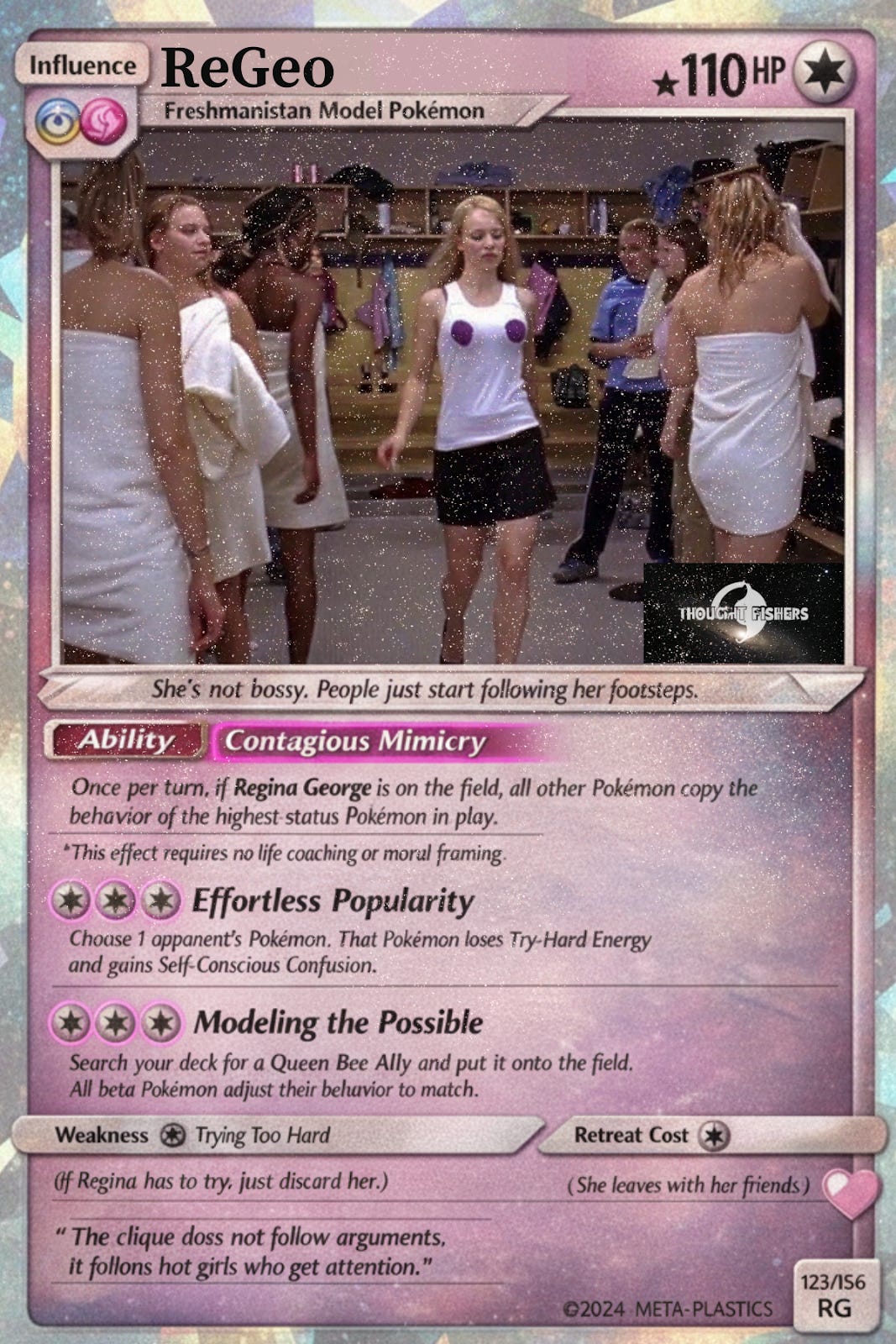
Troy was the popular jock guy who now sang, and suddenly everyone was in flux and wanted to reject their categories. Maybe some people genuinely felt liberated, but for most? Troy just made it look cool.
Troy and Gabriella became true leaders signaling that something new was possible and worth the risk. But the danger of being a bellwether is this: if people follow you for the wrong reasons—because you’re hot, because you’re popular, because you’re trending—your message dies the moment you’re not cool anymore.
In Mean Girls, Regina George fell from grace, and everyone abandoned her for Cady overnight. Similarly, HSM eventually went out of style, and then we forgot the lessons. We put the molds back on and began the motions of sticking to what we know. We didn’t internalize the hard questions it was asking us, we just performed it for nostalgia.
If you missed this lesson, it may be the fact Disney used the exact “status quo” tools the movie critiques to scale the story. We didn’t really see their humanity. We saw our celebristan heartthrobs. Hot people singing on our backpacks, PJs, and lunchboxes. We copied the surface—their categories, their “aesthetic”—not what they were reflecting back at us.
Maybe ‘failed art’ is the wrong idea to consider. Maybe this is the cost of making something cool in the world. When you reduce plot, composition, and characters to hotties singing on a lunchbox, that’s all they become. What’s the point of embedding a message into the essence of a project if it’s so shiny people can’t see past it enough to make a change?
You want us to be numb? You want to make “content” every week?
Think smarter. Get more creative.
Ideas get so dragged and drained, art becomes empty. The message dies fast. And we need more. More hotties singing on our cafeteria tables. More spectacles to attract our moth eyes. More tours for us to show others where we are. More merchandise to signal what we like. We’re empty.
I refuse to believe that’s the depth of human art. This is how society pimps out people and culture for profit.
Let’s wake up and stop pimpin’.
We're empty.
“ We wear the mask that grins and lies,
It hides our cheeks and shades our eyes,—
This debt we pay to human guile;
With torn and bleeding hearts we smile,
…
Why
…
should the world be over-wise,
In counting all our tears and sighs?
Nay, let them only see us, while
…
We smile, but, O great Christ, our cries
To thee from tortured souls arise.
We sing, but oh the clay is vile
Beneath our feet, and long the mile;
- We Wear The Mask, Paul Laurence Dunbar (1895)
Do you know how much you cost?
How much I‘d have to pay you to disbelieve that voice in your head?
How much would you pay to be something you’re not?
What good is it for someone to gain the whole world, yet forfeit their soul?
- Mark 8:36
Anthony Di Mello distinguishes between two kinds of feelings: world-feelings and soul-feelings. World-feelings come from external validation—praise, applause, likes, comments, followers, and winning. They’re momentary. A compliment lasts one sentence—if that these days. Money gets spent within a month. The dopamine fades in seconds.
You need more. And more.
It never ends.
Soul-feelings come from within.
The way a sunset looks through YOUR eyes. How a rhythm feels in YOUR heart. What YOUR favorite food tastes like on YOUR tongue.
No one else can know these ideas. They’re uniquely yours.
World-feelings are invented by society and customs. Soul-feelings are innate to your humans. World-feelings might feed you in the present, but they starve your soul. Soul-feelings nourish you—and because you’re a creator, your ideas and art can outlive you. Your thoughts. Your tastes. Your inventions. Your genes.
This is why We Failed HSM.
We, as society, choose with our attention and dollars, to value, world-feelings over soul-feelings. We wanted scores, to be popular like Troy, desired like Gabriella, seen like Sharpay, in proximity to worldly fame and success. We wanted external validation—the thrill of fitting into “a cool category”77—not freedom.
We sold our souls for spectacle.
The algorithm loves it. Empty people are transparent—they live for the world-feelings, pay for constant validation, and are easier to control and buy out.
We haven’t evolved, we’re empty now.
Look at the HSM characters, they’ve become obsessed with how others see them, and surveil each other constantly. We just moved the surveillance from the windows, to the movie screens, and now to our phones.
Chad is the perfect example of this surveillance projection in HSM1. He’s the first person personally offended by Troy singing. He acts like Troy’s betraying the entire basketball team by stepping out on stage. But the irony is: in his ‘persuasion’ speech, Chad displays an encyclopedic knowledge of musicians and music history. Chad could secretly love music.
We’ll never know. And he’ll never find out.
He’s trapped in his jock category too, he just projects his repressed desires onto Troy and attacks him for it.
How many of us have felt personally offended by someone else’s choices? Their beliefs, their style, their freedom? If you can’t ‘not be’ invested in someone else’s life, you might be projecting your own onto them.
It seems ridiculous when talking about a musical. But this same fear drives cancel culture, political polarization, family feuds, prejudice, wars. This is the same fear of duality. The fear that if categories break down, we won’t know who we are anymore.
Our earth is dying by our own hands. Protect your home, protect all you’re made of.
Take your mask off…
◐ See The Light
We're all in this together until he gets the first ticket out…
In HSM2, Troy gets a summer job at Sharpay’s family resort. He negotiates for his friends to work there too. He talks big about solidarity to boost morale—to ‘work it out’? Sharpay and the manager tempt him by giving him a promotion.
Baited. 🎣
Troy hides it from his friends. He tiptoes afraid to tell them—hiding, but it’s his dishonesty that creates the tension. Fear motivates hiding. Hiding leads to betrayal. This is how Control societies work. Troy in HSM2 almost becomes, just a dividual.

Control societies modulate who has access to information and access to their own identities. Your peers and algorithms decide who you are faster than you can process what is happening. Most people only realize it when it feels too late to stop it.
Amy Sherald’s painting captured this thorn for me- how long has she been this way? a Midge woman with dreary obsidian eyes—pits of questions into infinity, her regret I felt in her grip on My arm—she looked at me like she 'knew more about me than she knew about herself, having never had the map...' I will never know her, see her light or joy.
My visual reminder of who a Control society puppets: We look only at maps to understand, profiles enough to conform, and ‘they’ withhold our freedom to create our own map.

“The corporation78 presents the brashest rivalry as a healthy form of emulation, an excellent motivational force that opposes individuals against one another and runs through each, dividing each within.”79
- (Deleuze, Postscript on Societies of Control)
Deleuze, like Girard can map how corporations present rivalry as ‘healthy mimicry’. This is why Peter Thiel, a “competitive guy”80, argues that competition is for losers81 and you are not a lottery ticket82. Institutions stifle self-actualization at our core, don’t be fooled—know what game. For recognizers, this is difficult in practice.
In the face of fear over his future, Troy’s dad warns him: don’t get left behind at any cost. So Troy goes into survival mode. Survival mode is cold. Subconsciously reptilian. Fear and binary thinking condition your elephant to treat people as objects, as means to an end. Warmth is a privilege that requires slowing down, looking sideways, seeing people as human.
Troy gets divided from his friends through corporate rivalry disguised as “opportunity.” The resort creates games that incentivize not through service but relation, as a tool for Sharpay’s manipulation ‘to win’, not a reward for outstanding work.
In the real world, Troy could’ve made different choices. He could've earned the promotion by merit, or told his friends the truth: his family didn't save money for college and he'd do anything to go. That’s real.
Instead, he hides in his fear. He plays dirty and lies. He accepts any and all of Sharpay’s compromises, and humiliates his best friend in front of their bosses(People) over accidentally putting the wrong cheese on his sandwich.83
Then he acts surprised when his friends call him a sellout.
His friends aren’t wrong for feeling wronged. They were betrayed.
You can have transactions with capital (money for service, labor for opportunity, trade, etc.). You cannot have sustained relationships ‘as capital’. People are no longer forced to be the property of others, free to live and play as a human, which means we are bound to change and evolve.
Troy, like many in control societies, confused the two. While being used by Sharpay, he somehow lost his friends too. Troy's mistake wasn't accepting the promotion, though it seems that way on the surface—it was hiding it and lying to himself. He tried to control the situation, but had to learn the situation was not under his control.
Either way. Action was taken, and now there are lessons to learn.
A blonde black hole
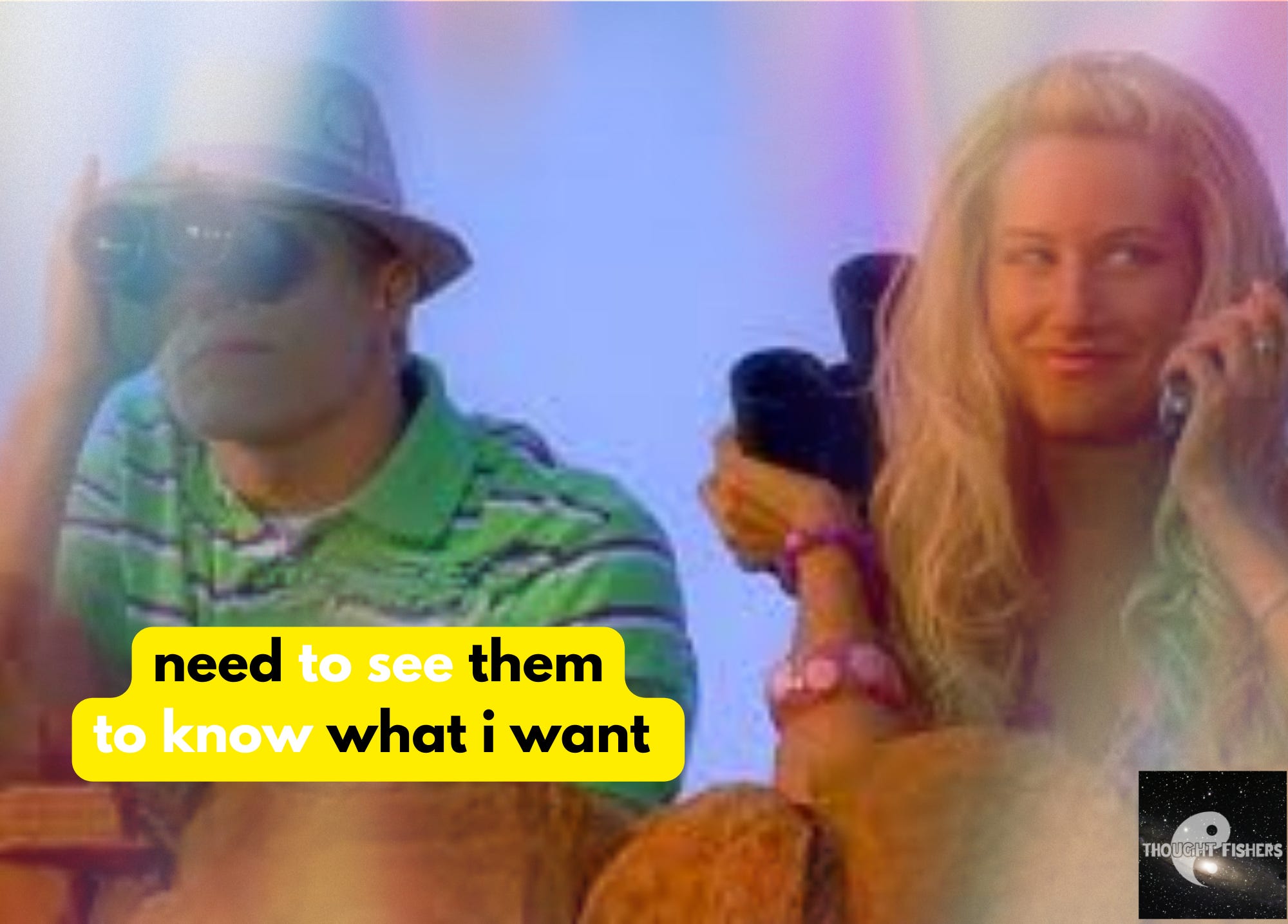
Sharpay still doesn’t have a life in HSM2. Her time is still consumed with surveilling others.
Have you ever really seen her?
For all her talent, Sharpay seems to have no real interests. Just hobbies and skills used as means to an end. She goes after what she wants shamelessly She doesn't pretend she isn't playing a game.
Sharpay makes me feel desperate, sad, and hollow.
Watching Sharpay is like watching a black hole in a blonde wig consuming itself. Endless hunger. Constantly trying, and failing—to fill her emptiness. Constant self-masking through external validation. It will never end.
It’s an addiction to fill emptiness.
Sharpay has limerence for what Troy and Gabriella have. An obsessive, dramatic, unrequited longing. She doesn’t want the love Ryan or her fake friends offer. She doesn’t want real friendship or admirers. She wants the symbol of Troy. She wants to acquire84 Troy as an accessory. People are means to an end—her attempt to feel soul-filled.85 Troy and Gabriella don’t reciprocate the time she spends thinking about them.86That’s limerence.
[give Ms.LaurynHill atl. 1 min to explain truth-telling]
The control society is made of people (agents) being used to maintain a system that thrives on lies and deception. So in every sphere of the world, it will always feel threatened by any truth. Tell the truth anyways.
Gabriella plays truth-teller, and confronts Sharpay by saying: you might win Troy, you might win the talent show, you might ruin your brother's performance, but at what cost?
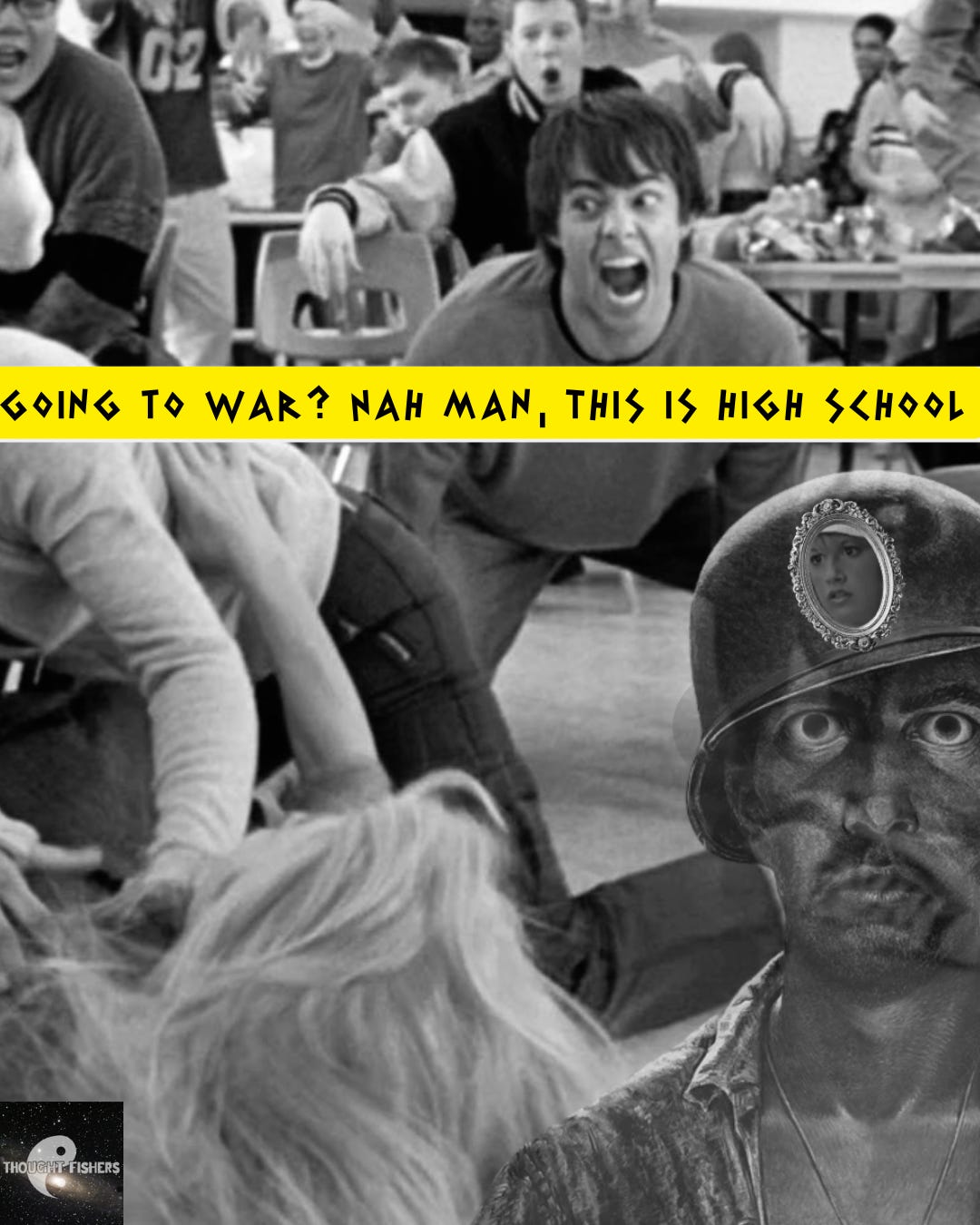
Sharpay reacts in this blank horror because she knows the cost. She’s living it—trying to fill her blonde black hole through winning. Winning fills you with temporary satisfaction, then it leaves you with lingering emptiness. That final echo of applause. The last of replies you’re responding to. The foggy memory of validation. It is never enough.
A lot of people are conditioned to value others this way.87 When someone in a relationship doesn't have 'enough' of value to offer anymore—status, usefulness, attractiveness, or money—the relationship gets tested. This is partly why the elderly are so invisible88 as most are running low in all categories of “value”89.
Troy overhears Gabriella confronting Sharpay.
He tries to apologize, but Gabriella is a truth-teller so she has the courage to name “the elephant dancing around him” the entire movie: “I don’t recognize you anymore”…
This moment matters with soulless objects as well… the object no longer has the same value if we can’t recognize it anymore…
This is where she leaves him, maybe.90 This moment matters because it’s the first time the stakes are high enough that Troy wakes up and tries to step into the light.

Oh Troy…
ultra swag boyfriend’s favorite scene91:
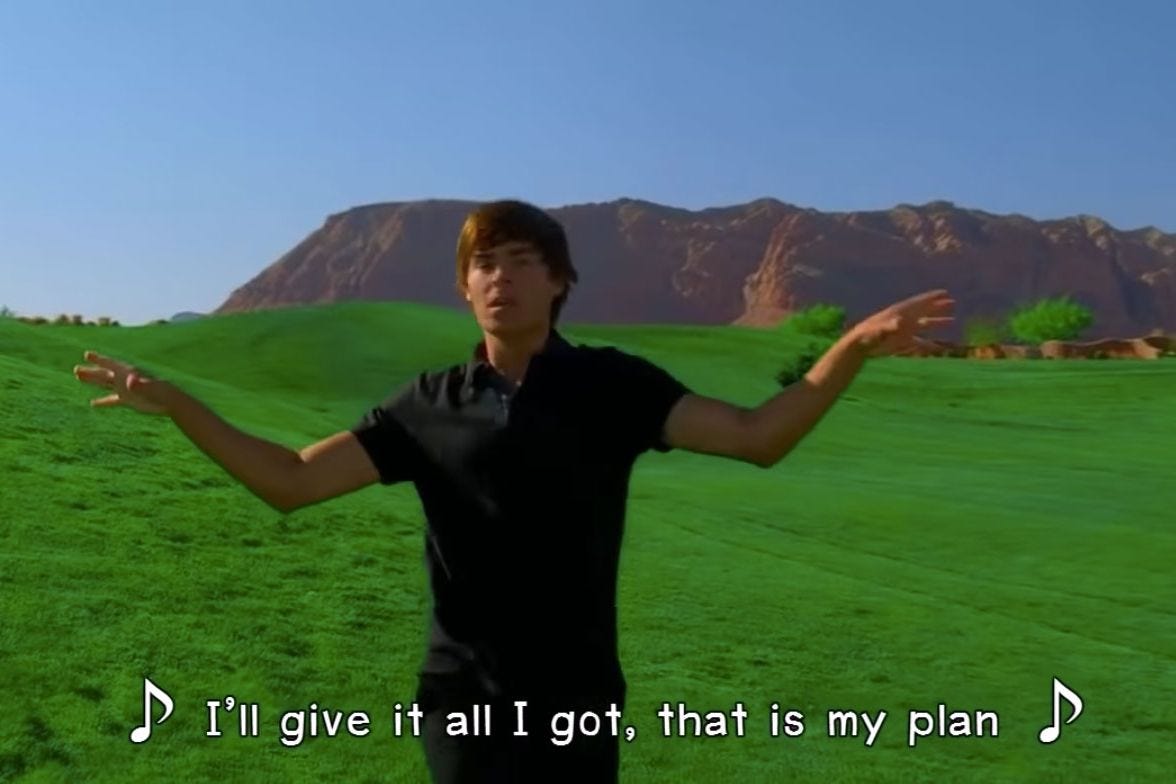
Troy, who was the first to name this incongruence in HSM1, almost learns the right lesson here—and then immediately unlearns it. He runs out on Sharpay mid-rehearsal, potentially trashing his scholarship opportunity.
Betting on it. He realizes he's sacrificed so much of himself that he doesn't recognize who he is anymore. As a kid, I found this new awareness very admirable. But now that I've run from my own problems a few times, it reads differently.
“Am I the kind of guy who means what I say? Bet on it, bet on it.”
~ Bet On It: Antonina Armato, Tim James, Jason Nevins, & Zac Efron
His friends weren’t upset about the scholarship. They wouldn’t have wanted him to trash his opportunity so impulsively. They wanted his words to have integrity—him to be honest. Troy was so blinded by fear of man that he couldn’t see this.
Don’t be like Troy. Pause.
[Listen to some EWF to see the next section extra clearly]
If you really stopped and feel things, whoever is feeling those things might be apart of the inner you need to protect. Your inner knows you best. The inner sees you fly. Always. It knows what makes you smile. But it’s so deep inside it’s too far to tell you clearly what it needs. The rest of your body knows this inner self is most valuable, and body will try to exploit inner to get what it can…is fragile.
Above all else, guard it.
See your light. Protect all it shines on.
[——only move on towards…
…. the end….
when you’re ready to think—]

Surrender to your humanity
“But we have this treasure in earthen vessels, that the excellency of the power may be of God, and not of us.”
The treasure within our earthen vessels is our humanity. It cracks easily under real heat—scarcity, pressure, temptation, brutality, and survival. And it cracks just as easily under illusory pressure from our own perceptions. Troy doesn’t lose himself because he wants success, he loses because he’s subconsciously selling out his (internal) relationships as a means to secure something external.
You don’t get to live in the light without first confronting your own darkness. Troy tries to skip this step and never learns that he doesn't need to give up his future to win back his friends.
The only way out was apologizing for the harm he caused and taking responsibility. Troy does this at the very end and his friends forgive him effortlessly.
Their effortless, Mute forgiveness reveals a failure in character design by the Control society. The supporting characters (outside Troy and Gabriella) are mostly static. They exist to dress the main characters, not to be fully human themselves—no meta-level desires, no unique arcs, no real evolution. Thus, the evolution of the background characters happens only collectively.
Unfortunately, like those side characters, our lives dress celebristans.92
Who could they be, if not for their fans? 93
You know how types of fanatics94 say 'we won' as if they get collect the check too?95 Didn't step on the field, didn't practice one note, didn't risk anything for the goal. Loud chants being rooted without relation. They want to Feel the victory without the process: it could be a deep inner feeling and appreciation and could also be an empty claim to someone else's benefit.
Celebrating someone else’s success, when they’re far from you, is easier than confronting your own work. I think that was our mistake looking at Troy and Gabriella. We said 'we're breaking free’ too, while wearing their faces on our PJs. We claimed their courage and freedom without doing the honest work required to follow our own hearts in our own life.
The film’s ‘unpredictable’ solution is revealing. Troy learns he has to work backwards to what got him the job in the first place—Sharpay’s crush.
He confronts her directly and leverages that knowledge to get his friends the chance to perform. If he’d just been honest about the source of his opportunity from the beginning, he might’ve come to this revelation sooner and with less damage to his relationships.
Sharpay had control of ‘their work world’ all along, but no power over herself.

“If legitimacy is ruptured, the chain of roots is no longer meaningful, and the community wanders the world, no longer able to lay claim to any primordial necessity.” -Édouard Glissant, Poetics of Relation, pg. 52
All this means, is that when “the stupidity of the game you’re playing is revealed”(true scoring system)—you no longer want to play. Sharpay is desperately trying to maintain roots for meaning,96 but has no relation. She’s hollow. It’s the consequence of looking ahead instead of sideways.
Relation gives you light. People gift ideas to the world. Seeing the light means that you spot a crack in the wall(a contradiction), as you investigate the light gets brighter and brighter. Soon you know it, you’re on the other side of the boundary-Free.
Apostle Paul teaches the difference between light and darkness, appearance and truth, the seen and the unseen:
‘Instead, we have renounced secret and shameful things, not acting deceitfully or distorting the word of God... but commending ourselves to everyone’s conscience by an open display of the truth.’
- 2 Corinthians. 4:2, NIV
Sharpay is blinded not by evil, but by illusion—symbol over substance. We get trapped in this same blindness because of the world’s chaos. It's hard to live in chaos every day, sometimes debilitated, overwhelmed, knowing97 you have all the power to create."
You’re fooled by randomness. Fooled by man. Fooled by your mind. Tempted to control the chaos. To impose your will. Only to realize what made it easier in the end was surrendering control and listening.
The only control that matters is self-control—how you react, what you choose, what you think, what you create.
who you becoming?
○ Own your becoming
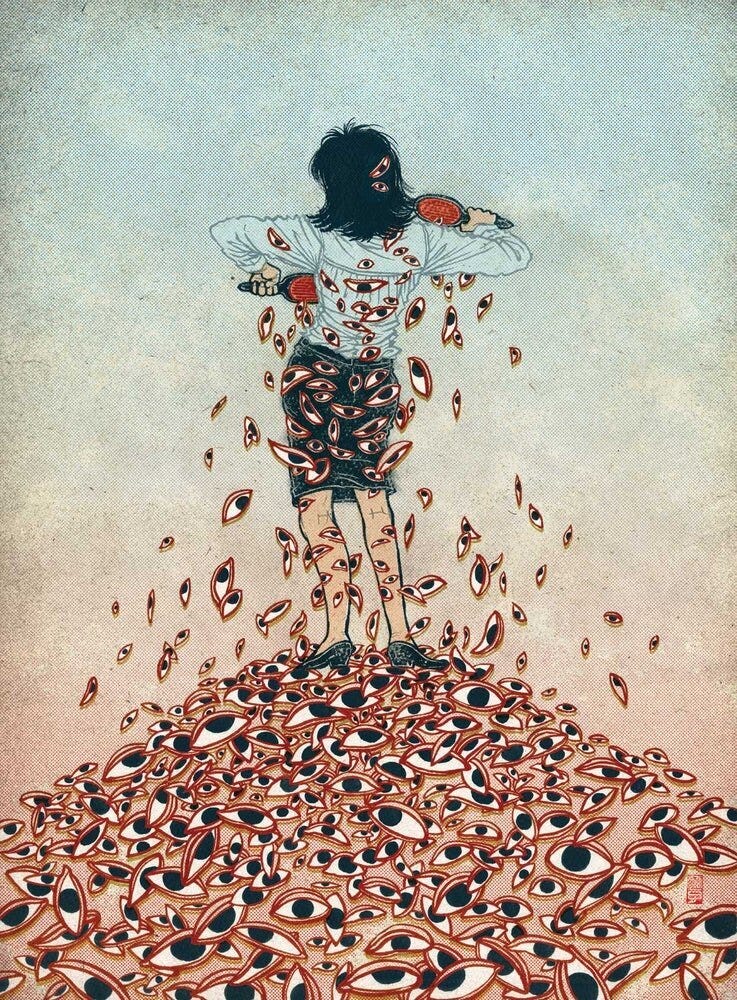
Yuko Shimizu titled this work “Dusting off the Male Gaze.” But it’s not the male gaze we need to dust off. It’s the human gaze—the way we’ve learned to see ourselves as objects to be judged, sorted, and consumed. When you point your finger at someone to judge them, look down.
.
.
.
You’ll see four knuckles punching back at you—watch out! The human gaze trains us to perform. To mechanize. To optimize. We learn to see ourselves the way we imagine others see us. We become our own surveillance system and reinforce factory eyes everywhere we go.
here’s the Truth: No one is looking at you the way you think they are. They’re too busy worrying about how they look. We’re all trapped on one digital Earth98, watching ourselves be watched.
don’t worry people of Earth.
Social media as an opportunity
The platforms are misaligned with human ontology. They’re built on old hardware trying to run new software—computers don’t have a real feelings for what humans actually need. How do you capture a multi-dimensional person in a 2D space? You can’t.
That’s why the the design and language matter so much. Instagram calls them “Followers,” not “Friends.” Facebook gives you a handful of relationship categories. Snapchat gives you six types of friends. Each platform reduces your relationships to whatever fits their data model. And how you use (or don’t use) these tools determines how you feel inside.
Doechii99, an artist, said the problem with social media is that it doesn’t show us how others perceive us. Initially I agreed with her.100 I have a real desire101 for true social networks—aligned discovery and connection.
I thought about how I see others in a light they don't see themselves. What's lost online is our multiple dimensions of self. A 2D world can’t capture all our angles/dimensions of our person.
I was not the biggest Lil Yachty fan in 2016 when I first heard him. I put him in a mumble rap category and dismissed it. I told “the world”, and ultra swag boyfriend that content-wise and instrumentally he wasn't my vibe.
Then here I am, and ultra swag boyfriend is randomly rapping to Coffin in the car one day...I tried to keep a straight face… But Damn it, I was ill102 hearing Yachty rhyme with my soul for the first time…Sometimes all you need is a little experience and inspiration to see what you've been missing.
I am Mimetic, by nature and by choice. I feel really real to me, but a new trap and drill lover—you see. I love to rap, I love rapping, and facts, learn-ing, about life, ask-ing questions at the speed of light. No actually. Light-ning in daylight. Ideas spring forth. Lightning I don’t see, in the moment. I don’t pay attention, my inputs came too fast to code. I just hear and recognize, it happened.
For the trap red-pill, all I needed was to pay attention: seeing his joy, the color of the fire, hearing him rap over the song, and the tension of the beats. Sure, I could have just admired him, but investigating my own desires led me to listening to more songs. And more. and Now I’m rapping beside ultra swag boyfriend. I’m rapping for my inner.
Protect your øpacity, but share your truth when you want to receive. There’s been little time in human history for the Freedom to choose. Before you diss the digital, remember that we’ve never had a social space that could actually house all the human103 of us—tell someone or something what they’re missing of you or let them know even less. Demand the room and incentive for your øpacity.
Maybe you say:
f*** it. f*** the digital world. F*** evolution.
Cool. You don’t need the bits, stay in your own world—“offline”… Then again, all it takes is a few of your favorite friends to be really active online, for one small group can shift the direction of the entire flock. So, only you can figure out what use and non-use looks like for your life based on your awareness of influence.
If you stay online, and find social media makes you feel empty, drained, or performative—ask yourself why and how. What are you actually doing there? What are others doing? What changes would you make? Then try and dive deeper.
Are you curating for an imagined audience or sharing your own world? Are you consuming others’ lives to avoid building your own? Are you scrolling to pacify your mind or to connect?
Your answers reveal what you need.
and Ňow, I believe something different: With øpacity freeing you, it’s your burden and responsibility to share who you are, on your terms, so perception can’t stay biased. It should not the burden of others to see you as anything more than human with the blind eye.
People will default to their own assumptions unless you disrupt what you care to correct with your truth. If you only show people one side, then they won’t see you as anything else. No one will see until what you’re suppressing comes into the light. If you aren’t aware enough to see it, you might lose self-control over what gets known, how, and when. The right to øpacity doesn’t mean you stay in darkness. It gives you will and ownership over what comes to the surface.
For that reason, I love digital spaces.
I moved around a lot as a kid, so I was conditioned to become many different people. In consequence, I ran low on “roots to maintain” IRL—with no stable community to fit in with for belonging that didn’t oppose another. The internet and social media became my continuity of self. I was never able to forget the many sides of myself because they were all archived somewhere online, but I got to change usernames and hobbies so often—I tried a lot on. That’s why I can still chase the dreams of my 5-year-old self104 today. I knew my questions, my voice, my ideas, my taste, my memories, my mistakes—all recorded to one day help me return to myself.
Social media was once a superpower for maintaining multiplicity across place and time.
But as much as real people made my social media experience meaningful and fun, those same people, including myself, were incentivized by the platforms to treat people as content—data. So even when I was using social media to stay whole, the system was designed to fragment me.
That’s when I realized I needed to take power back on my terms.
Stage of choosing
Now I reflexively share whatever I want to multi-modally archive, curated moments of my life, regardless of P.O.105— it feels good, becoming Free.
What helped most was unfollowing people whose “content” I didn’t like or care106 for, common sense…The game Instagram is hosting is a marketplace107, so I need to filter and think critically about my plays: what or who am I “buying” and “selling”? Do I even want to be a player in here?108
Part of why having zero followers feels more honest is that I'm finally posting for myself, curating swag moments I can share with an audience that I select in any place or time in the future at my own prompting, not on a feed's schedule. It was sobering to watch the time I spent scrolling and surveilling decline, it was also sobering so see how little people want to engage with me without the collective eye. #lo..ne..ly…
Don’t wait a decade like me. Take a risk and try a new lens today. You have a vast world of Earth and bits to explore. All for Free.
Find a system for returning to yourself and giving yourself back to the world—even if it's analog. Write it all down if you need to. Because if you don’t tell your story, someone else will tell it for you. And we both know what that turns into erasure on a long enough timeline.
I’ll be ready for an audience when I can stay authentic without pimping myself out for belonging. But I don’t need an audience for community. I participate in the world through relation.
The i questions to ask are:
i→ Can you stomach being seen AND keep returning to yourself?
i→Can you stomach honesty AND letting your truth go into the world?
Am i strong enough for that coherence?
Man in the Mirror, make that Change.
The Problem is US109
We all want to make a change, but refuse to see into our own mirrors.
When it wasn't AI "ending us," it was social media. When it wasn't social media “rotting brains” anymore, it was the internet. “Personal” computers. “Smart” -phones. Cars. Airplanes. TV. News. Media.
110DOOM. Can we get a break?
If you're looking for someone to blame, you can look in the mirror—and remember. We are the Control society.111 “Them” is US. The human race.
We were asleep. The categories were built over centuries. The molds were pressed into our clay before we knew how to speak up—and say no. We play this game by voting with our dollars. So Control society wins by making us think as little as possible, for as much money possible. The algorithms learned our desires before we understood ourselves. We didn’t choose this, but we’re the ones who have to wake up from it—to change it.
The mind is both the tool and the body is creation. That’s why it’s so hard to think critically about the ideas in our own heads. You can’t examine the lens while you’re looking through it. But you can choose a closer scope. To pay attention. and Truly see.
Every “abstract” thing in our physical world was discovered, created, and reinforced by individuals and their ideas. We first started looking in the mirror for “Them”, checking if we fit the image “They” wanted to see. Not looking at ourselves with love even when they don’t like what they can’t see.
In turn, our reflection became foggy. Earth became a foggy world. A polluted world.
Choose to look and see:
When I look at the mirror, it’s hard to escape the other. I recognize its’ cold inquiry immediately. But when I look in for myself—I find her down there in her village. And I ask her to come out and lead.
Return to the Mirror

You must take the baton, and come out into yourself. The song starts with a man looking in. It ends with seeing a better world. X school will always be a rotten place if we’re spoiled people. So look within, listen, and ask who?
Good people are just aware people who make change. So do try being you.
Individualism is a responsibility to yourself and communities112—for becoming. Evolution as an individual is not isolated from the world you react to. When focusing on becoming, you give your communities a true part of you, not an empty coerced performance.
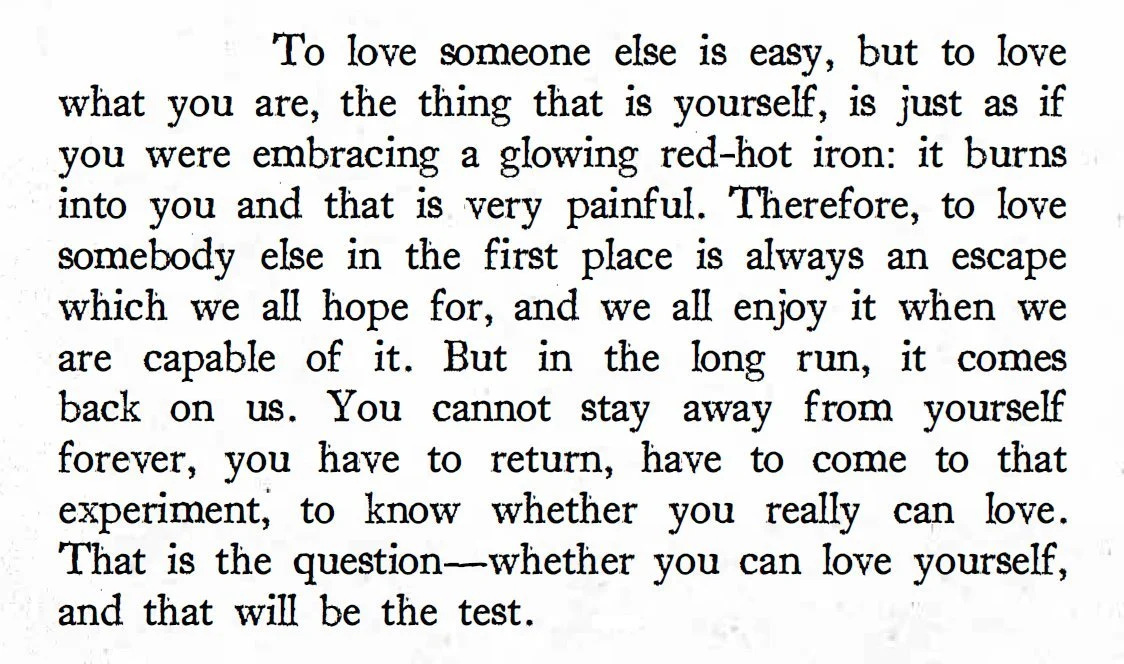
Whatever you are, learn to love your human. Once you love your self, only then can you be your best. Symbols are interchangeable. Your community doesn’t need another symbol to identity with (it). They need the message of your humanity. Your multiplicity. Your soul.
The Work Required
“If they can get you asking the wrong questions, they don’t have to worry about answers.”
- Thomas Pynchon
Ask the right questions. Free markets need free humans. (mafa)
The Control society is enemy to everything free. It needed us fragmented, dividual-ized, competing constantly to compute us. Because if we actually saw each other in our full multiplicity, the categories would collapse. The molds would shatter. The factory would shut down.
Just as Jack gave Rose the light to see her freedom in Titanic113:
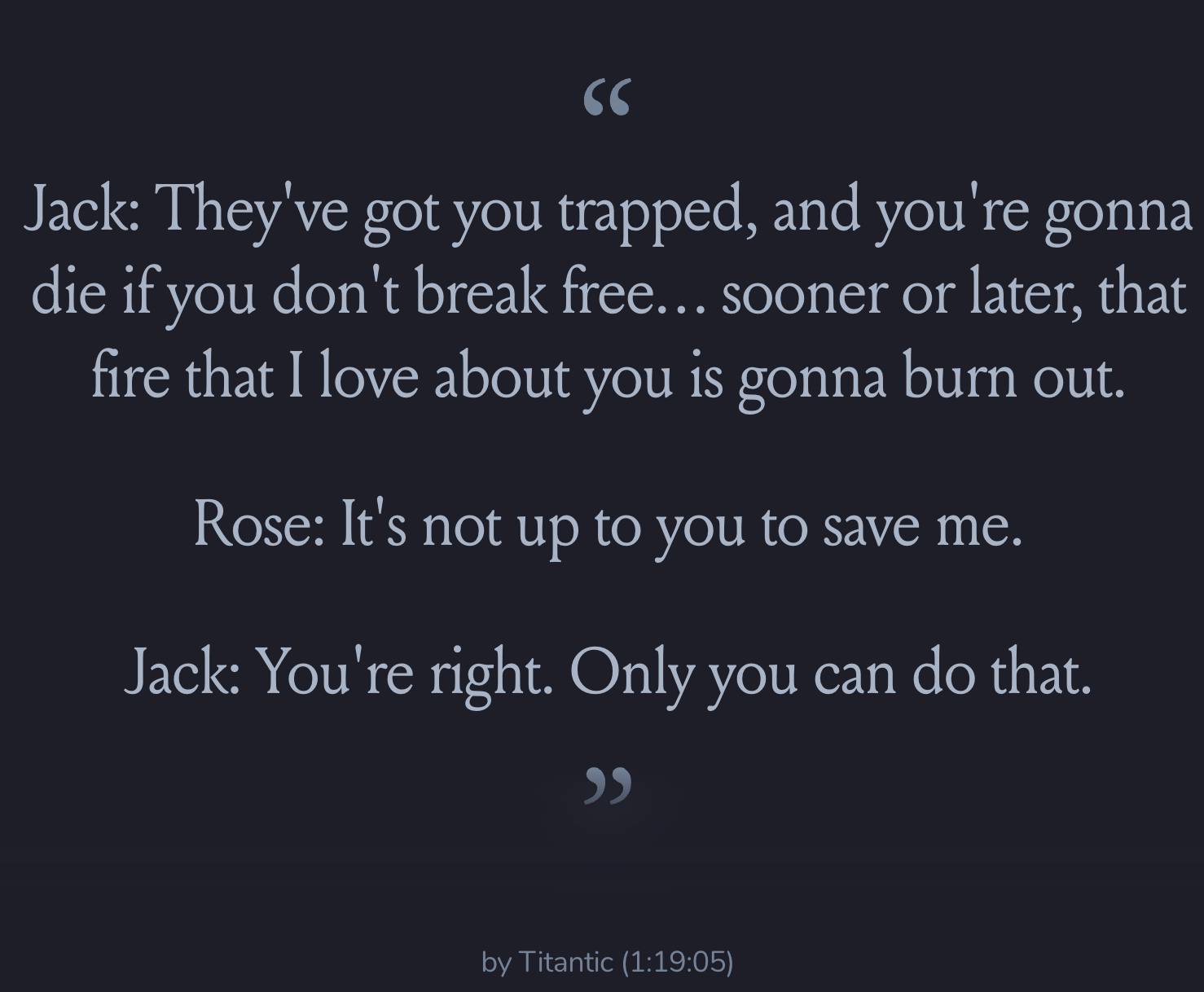
Only you can do that. No one else can discover your soul for you. No one else can ask what your soul is trying to say. This is your mirror, but stay attentive to balance.
Your fire can burn out from fighting everything or from fighting nothing. Don't be radical with your energy and try to fight it all.114 Many before you have paid with their lives already. Live yours. Pick and choose your battles.
Life has far too many choices, but we should think about why we’re choosing. Yes can be good and fun for the moment, but that doesn’t mean it will be harmless to your reflection.
Say no when you know the cost and benefits of yes, then you can discern what you want to pay and why.

🚥 Kendrick Says…
Are you real? to you
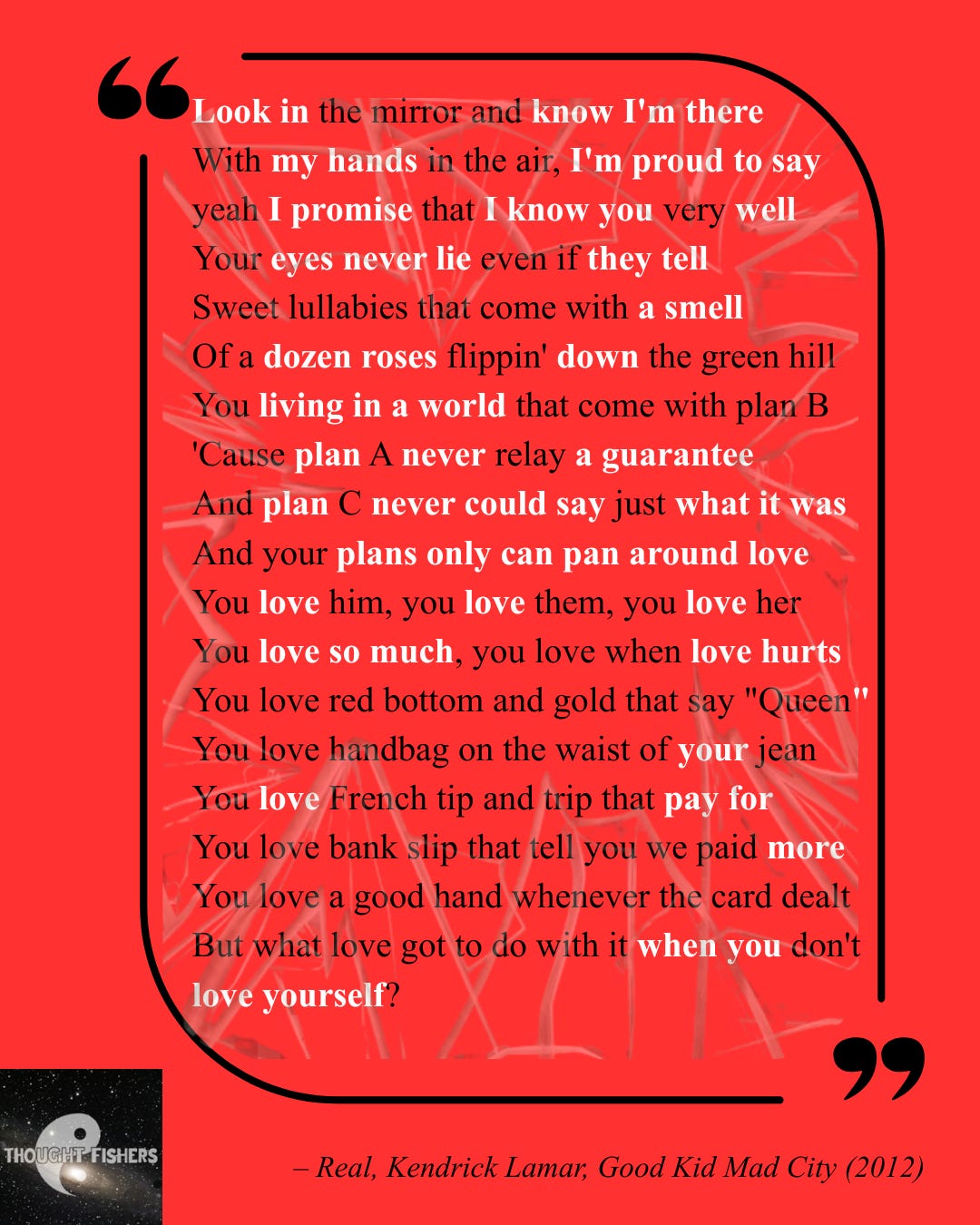
I wish you love. Who you could be is a mystery. So survive. Think different. Create some thing. That’s the homework.
Something New
So is it a failed art? Did we fail the art?
We know High School Musical didn’t fail artistically or commercially. As I mentioned at the beginning, it scaled everywhere: spin-off movies, book deals, costumes, video games, clothing lines, TV shows. But when evaluating art, we should recognize that art is a reflection of the human soul. The soul always has a message. Projects like HSM are hard to evaluate because so many souls go into it. But I tried to honor everyone who made HSM because they went there with all their hearts.
Unfortunately, the message didn’t land on the society beyond the moment. But, the message is still alive, burning in 2ø26 beneath the spectacle. It’s not that the team failed us—it’s that the noise was loud and it defeaned our ears from listening to the signal. So the message never got a fair shot at being listened to. There’s not a star in heaven that we can’t reach, if we stop blindly obeying the boundaries of categories, stop hiding in the dark, stop selling our integrity for the feeling of survival, and choose the risk of being.
Maybe then, that will be the start of something new. We have the medium. we live in an ALL world now. Own your creations. Respect your right to øpacity. Reject the categories. See each other as fundamentally different (as individuals), yet fundamentally human (as whole).
Converge on values, not symbols. On soul, not spectacle.
This is how inspiration reproduces. This is how we stay alive.
The choice is yours. Your Freedom is waiting.

Hi stranger,
I know that was long, but since you made it here—I know you listened to me. My hope is that you feel revived, a little more Free, a little more confident in your human ability. Life is very hard, and it’s going to get harder everyday.
Listen to your senses, don't trust them just yet. Eyes deceive. Trade your fears for sight. See what’s beneath.
to re-Introduce myself to you. I am philosofounder, and philoso-founding115 is your tech-nique to create things with wisdom. It involves creation in light of truth and unconditional love. As a person of Earth, you must be willing to commit your life to to yourself so that your seeds bless our home to one day leave our solar system. Lest not waste time for such a short trip on Earth.
Be still. Play. Love. Being.
Avoid the trap of not reasoning:
“Perfection of means and confusion of goals seem – in my opinion – to characterize our age.”
– Albert Einstein, Out of My Later Years, 1950
(From the series Great Ideas of Western Man)
You can grow, and never grow up. The world deprived of wisdom is like quick sand. Don’t get stuck in NeverNever land. Wake up and step into the light. Exercise your reasoning to remember your why because if you remember your why, you will survive!
I’m so proud of you. You were in labor for hundreds116 of hours in the amber light, hungry, possessed, postponing all, saying hold on—this is for me—while spitting words with numb wrists for you to always return to who you are; to discover who you are becoming. You made over 1000+ edits, start to present, and you must keep editing these ideas until it’s in print—until you feel it. Don’t forget that moment of completion.
Until you don’t wake up in the morning—never stop becoming.
your why,
philosofounder
🌏 seed ~ MacKenzie Fisher
→ vistors yo yo yo! 🤗
what an exorbitantly long way to say hello... This was really embarrassing to post, but I feel better now that I let a part of me go out into the world so let me know if you relate :) also, reach out with anything on your mind so I can learn from you— to be better together.
epistle i is part of a larger project…say a little prayer for me, and look for the more in futuro. I’m doing all I can to create the world I want to live in. A Free society-All world in relation, and I would love to know you as a person and what your life is like. It can only bring hope or pose more questions for both of us to think about.
If you’re here with me now, thank you.
Have a good 2ø26.
peace & blessings ✌🏾🍀,
philosofounder_
email: mackenziemichellefisher@gmail.com
phone: +1 [864]-907-9757
#Don’tFollowMe
if you relate with your eye, lets be talk <3
W.M.I.C.F
where my ideas came from
Essay: Writes And Write-Nots by Paul Graham
Essay: The Fall of Man by Reggie James
Youtube: Window Seat: Erykah Badu
Chapter: The Medium is the Message by Marshall McLuhan
Letter: Steady Progress and Self-Reflection by Brent Beshore
Essay: Made for the Moment by Reggie James
Quote: Albert Einstein Optimization
Youtube: The Monkey Business Illusion
Article: Inversion and The Power of Avoiding Stupidity - FS Street
Article: The Great Progression - Peter Leyden
Movie: High School Musical - Disney
Movie: High School Musical 2 - Disney
Book: I See Satan Fall Like Lightnight by Rene Girard
Book: Things Hidden Since the Foundation of the World - by Rene Girard
Reddit: Big Boi Pants
Book: The Score: How to Stop Playing Somebody Else’s Game by C. Thi Nguyen
Article: Disney Channel's "High School Musical" Makes History as 1st Full-Length Feature on iTunes
Youtube: Gilles Deleuze “Postscript on Societies of Control [22 mins]
Essay: Postscript on the Societies of Control by Gilles Deleuze
Essay: The Decline of Deviance by Adam Mastroianni
Song: I’m Real by Kendrick Lamar [worth all 7 mins]
Article: Mimetic Desire 101 by Luke Burgis
Youtube: Control Societies & Cybernetic Posthumanism [18 mins]
Image: Mimetic Machine Shapes - I don’t remember where I got this from... likely Luke Burgis or Peter Thiel somewhere 3/4 years ago
Youtube: Kenny Ortega on the Moment He Knew High School Musical Would Be a Hit
Youtube: What Kenny Ortega told ‘High School Musical’ cast before ‘We’re All In This Together’ scene
Picture: School of Athens fresco by Raphael (1509-1511) / Apostolic Palace, Vatican City
Think Tank(Hoover): Investing in Bad Science by Henry I. Miller
Stanford Mag: #RIPEminent Theorist by Julie Muller Mitchell
Essay: Being basic - Nadia Asparouhova
Video: The Industrial Revolution (from my 5th grade class)
Reddit: Jung on Nietzsche’s Zarathustra, notes of the seminar given in 1934-1939
Museum: Great Ideas of Western Man
Article: Mental Model: Bias from Insensitivity to Sample Size - FS Street
Essay: What is Captialism?
Slides: Mimetic Theory Fromex-Sheep ScapeGOAT’d gZ Girardian
Song: God by John Lennon
Book: All Desire is a Desire for Being by Rene Girard, Cynthia L.Haven
Interlocutors(in my hive mind):
God, James E. Ambroise IV, Rene Girard, Édouard Glissant, Marshall McLuhan, Anthony Di Mello, Luke Burgis, Reggie James, Eugene Angelo, Apostle Paul, Plato, Peter Thiel, Richard Feynman, E. Badu, Kendrick Lamar, Bertrand Russell, Amy Sherald, Octavia E. Butler, Harry Gandhi, Norbert Weiner, Lorenzo Barberis Canonico, Maxwell Fisher, Mathis Fisher, Miles Fisher, Cyan Banister, Ayn Rand, Buckminster Fuller, Brent Beshore,
many more, as I remember I will add
extra;) Thoughts thinkin loud:
Both Ortega and Barsocchini (SF) are Bay Area seed!—🤌🏾 Ortega was a cheerleader at Sequoia High School, and if you don’t know his grand portfolio of art—check this out RIGHT NOW!
Tell me how it made you feel, I cried rewatching. Ortega is an OG creator of “teen experience”…
HSM*
pre-Algorithm
especially boys

Not on Instagram…or Snapchat… definitely not Facebook, maybe if you’re 50… maybe TikTok? Maybe. nah. no.
(purchase or participate).
(spectacle)
the infamous inhuman body
“Eat your food before it eats you.” - my grandma
what infrastructure can?
multi-dimensial and sensational
whom is evaluating whom… #humanauthority👎
value = what is important
Shouldn’t we be playing with our tools? Why is my device playing me?
That’s what sHE said…
(ex. influencers, “creators”, micro-celebrities, even college grads as success stories to entertain and motivate the rest)
GOAT PHILOSOPHER!!! SO@Dialectic for introducing me! He’s a professor at University of Utah, which is a now one of few reasons I would want to visit Utah xD
Or don’t and pretend they aren’t there… but does that really help you share?
ReGeo Poké ‼️🗣️
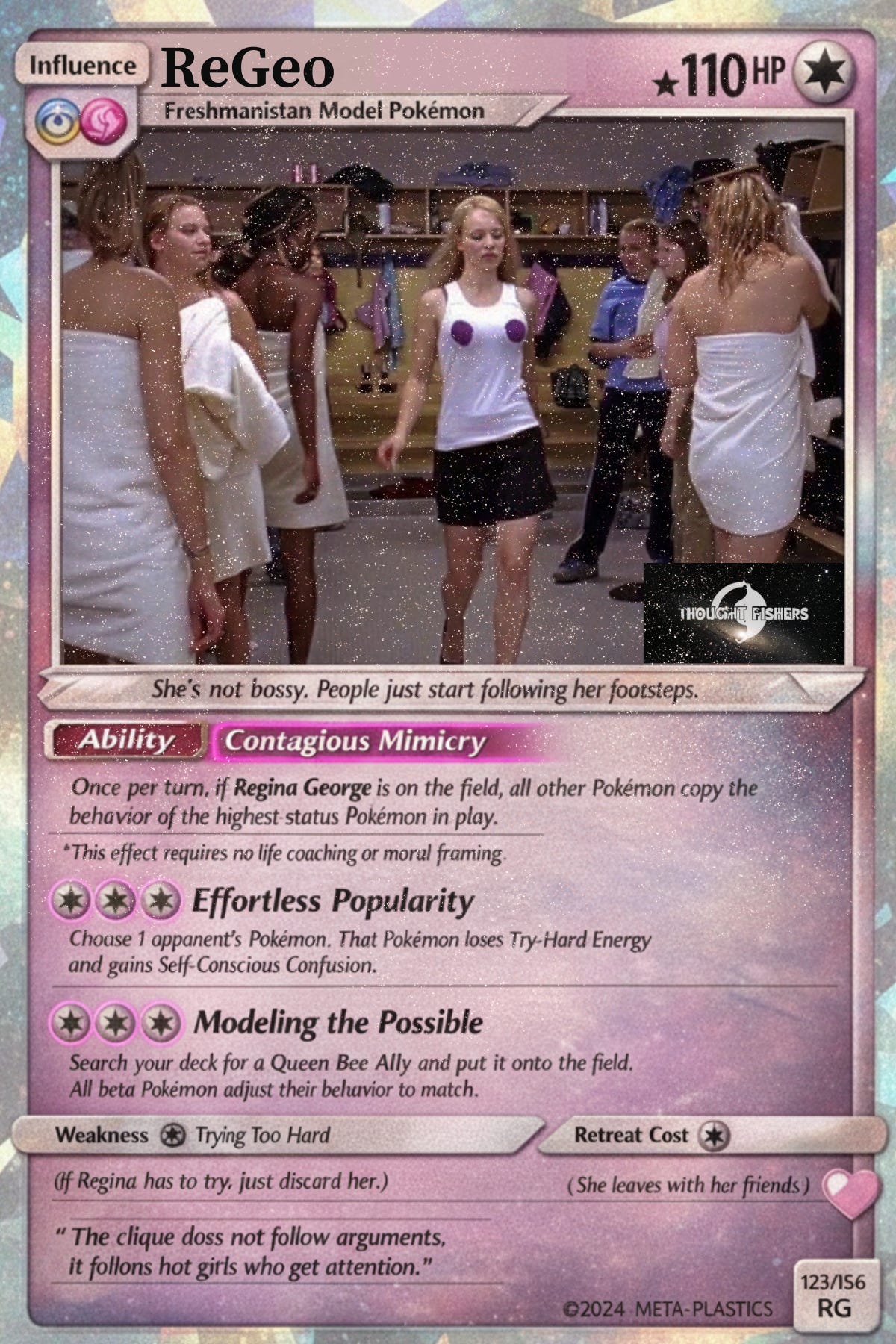
ex. Connection and expression are inner pursuits, but need new tools to help facilitate their complexity.
Reggie James writes about “The Moment“—when you command clear attention as the center of the most important environment. HSM had The Moment in 2006. Now we’re all chasing micro-moments on every platform, fragmenting ourselves for approval. The Moment used to be earned through performance, coherence, and narrative. Now it’s manufactured through metrics. [Read his full essay W.M.I.C.F]
= right now
CashMyFreewillHowBoutDat… Not Cashmeoutsidehowboutdat?….
my “ultra swag” boyfriend didn’t like ‘cutie’
(unless you count the occasional awkward jump, when T.O.K.W.C hittin moves, or the stiff/crunchy gyrate in a circle)
T.O.K.W.C = that one kid with confidence (some might call this kid autistic or weird, but i really admire and was inspired by whomever brave enough)
How to cost benefit analysis
n ill 🐦🔥
There are a thousand movies with zero Black lead characters I could name, and now that there’s ONE, I HAVE to play her?
Monique nearly quit acting when called back to audition for Taylor. After arguing with her team, she eventually auditioned: "I connected to who I felt like Taylor could be to other people who needed more colorful role models. I really wanted my nieces and godsisters and just other girls like me growing up that didn't have a role model… [to see themselves as] the smartest girl in school."
or was it??
This is why celebrities feel this the harshest, and you can see it most clearly in our games. Ex. Cancel culture is our peace to resolve the pedestal we reinforce.
Sharpay and Ryan Evans were originally written to be Black characters, but then they found Ashley Tisdale. Thank God for that!
Race was constructed by racists and is upheld by racists- all who use it end its’ victim even if they don’t know it yet.
the factory calls them “illegal” the people call them “aliens”
Not ‘male’ men, hu-mans.
SZA is another good example of how celebrities are incredibly dehumanized, and have been.
😉 secret advantage
play and metamorphosis
“According to Plato, for any conceivable thing or property there is a corresponding Form, a perfect example of that thing or property. The list is almost inexhaustible. Tree, House, Mountain, Man, Woman, Ship, Cloud, Horse, Dog, Table and Chair, would all be examples of putatively independently-existing abstract perfect Ideas.”
In The Republic, Plato proposed a rigid, hierarchical society where people are sorted into three strict classes (Guardians, Auxiliaries, Workers) based on their soul type. This was intended to bring about justice and harmony, but in practice, this “sorting” was totalitarian. It suppresses individuality in favor of the state’s functional needs.
(a scapegoat)
Varna system was originally a merit-based classification of roles intended to function as a reciprocal social body. But Hinduism’s concepts of dharma(path/duty) and karma(action/consequent) provided a theological framework that became institutionalized into an oppressive rigid, birth-based caste system, turning fluid social groups into fixed legal categories, entrenching occupational and marriage restrictions that still persist today.
Ex. Confucianism, the dominant philosophical framework in China, Korea, and Japan for centuries, emphasizes a strict, hierarchical social order based on the “Five Bonds” (ruler-ruled, father-son, husband-wife, etc.). It prioritizes stability and filial piety over individual equality, promoting a top-down, authoritarian approach.
Ex. Ubuntu philosophy, “I am because we are”, emphasizes the collective good. In many African societies, social organization was (and still is) strictly governed by age-grade systems, lineage, sex, and kinship, which defines an individual’s roles and responsibilities. Many African philosophies view the self as realized through the community.
Their thoughts like art on a page being so early in writings’ history.
Contextually, it could be. In Malcolm X’s example, it was not…
Think swagger. (Outkast @ 2001 MTV Video Music Awards)
![Apple Launches iTunes Match with Release of iTunes 10.5.1 [Updated] - MacRumors](https://substackcdn.com/image/fetch/$s_!96p6!,f_auto,q_auto:good,fl_progressive:steep/https%3A%2F%2Fsubstack-post-media.s3.amazonaws.com%2Fpublic%2Fimages%2F9b7820f8-0356-448b-94c4-371364101a96_1600x1200.png "Apple Launches iTunes Match with Release of iTunes 10.5.1 [Updated] - MacRumors")
iTunes in 2011 made my dad’s music taste look as beautiful and colorful as any real life record library.
or their determined circumstances... 🎲👀
help me create a Free society
mafa (silent i;)
laughing alone in my head, lol is just convenient
Yet, quantum entanglement shows that some particles can share a single spread quantum state, so their properties stay tightly linked no matter how far apart they move. So not all physical things are completely independent and self‑contained.
And atomic theory reveals a staggering paradox: we are not full of tiny solid marbles (atoms), but minuscule(empty infinite)nuclei suspended in place by unseen structure of quantum forces that give matter stability and shape.
A MUST WATCH!!!
Reppin the Akan people of Ghana, the largest ethnicity in West Africa, the phrase is a proverb that serves as the philosophical foundation for the Sankofa symbol, which is part of the Adinkra writing system. Also, fun fact.
The ALL world man, Édouard Glissant! The founder of opacity… check him.
“one world in relation”
we can make his legacy a reality ;)
quotes bc I guess I am a Western philosopher too 🇺🇸 🤟🏾
The #OutKast Exile life, true to it—ain’t new to it.
Again, through the Dialetic podcast!!
Also from the same Brie Wolfson episode [footnote 60]
[click me]
Maybe because they’re singing a love song as siblings who barely like each other lol
I imagine every scary situation as a Divergent fear aptitude test. Like Tris, I tell myself the fear isn’t real—but my choice to face it is.
This scene, like many, is not realistic. Troy and Gabriella could have just talked to the teacher—they’re the ones with scheduling conflicts. But we’re not here for realism in this moment yet...

This is craft. They worked for hours learning how to look like they knew basketball. Singing and dancing and playing—perfectly.
ex. Ubuntu, Daoism, & Indigenous concepts
If Gabriella can be beautiful AND smart, what does that make Sharpay?
0:27, stupid shorts
I used to think mines was Awkward Black Girl— I mean this is definitely me, (a side atleast😅)
corporation ≠ captialism
“Enclosures are molds, distinct castings, but controls are a modulation, like a self-deforming cast that will continuously change from one moment to the other…. The factory surveyed each element within the mass, the unions who mobilized a mass resistance. “ - more on this
the outward illusion
tldr; monopolize yourself, there is no formula, differences are underestimated, we’re tempted to lie and pretend
If my friend humiliated me in front of my bosses, I wouldn’t be as quick to forgive and forget with one “sorry”…
(“identity”)
= satisfy the soul, inner essence of you
Something my dad taught me, never spend more time thinking about someone than they’d spend on you. Catching yourself in limerence is easy when asking that question and answering it honestly.
In the Bay Area, I watch this play out constantly: 'friends' or people you connect with who cease to exist once they've extracted what they need, or recognize you appear to have nothing to give them.
money, status, attraction, service, etc.
what we think we value
“Maybe” because they were losing me at this part of the movie unfortunately…
Fun fact: HSM was green-lit from the first draft. Disney wanted a musical that both boys and girls would like.
coined by Luke Burgis
As a Fan, you might Feel you share an identity with the artist…that’s impossible. you could be mimetically attached to a symbol of something you desire… either way it would cause your dehumanizing them.
“How dare they act in ways we don’t like ?” -
“We made them famous, and we can take it away.”
Fanaticism is uncritical, obsessive enthusiasm towards a domain or person(aka fandom). It manifests in sports, political, nationalistic, music, pop-culture, or ethnic-group contexts— any rigid ideological worship.
In France, things could even get violent over football. My first time in France was during a violent riot over a football loss.
(roots might be: theater kid, singer, beautiful, wealth, social capital)
from this point it only gets rougher💥
(panopticon → Participation became a performance rather than a real conversations)
Alligator Bites Never Heal was so real, and a revitalization of what it means to play with hiphop.
I even thought about a content drone prototype my friend was making, and briefly thought more surveillance could repair this… pray for a techsis!!
Girard says we can be real if we transcend:
“Desire is undoubtedly a distinctively human phenomenon
that can only develop when a certain threshold of mimesis is transcended.”
– Rene Girard, Things Hidden Since The Foundation of the World, pg. 283
sick, cool, dope, fire
(sides)
🇺🇸❤️🩹🩺🛸🌏🌀💫🇺🇸
= public opinion
= bandwidth or energy
self-promotion casino —- gonna catch em allll (Pokemon) hearts and comments
the visual world: the stories, the memes, posts, text, the debates, the news, the music. Instagram can become a whole time machine—atleast thats how I use it!
mafa(silent i..)🇺🇸💔🌎🙏🏾
mf-
(next gen ofc)
the key difference between “collectivism” and “community” is your freedom to disagree with the group…if everyone is only expressing reinforced opinions, everyone just sticks to what they know and doesn’t grow
Aside; Jack was a real truth-teller! Rose was in denial…
unless all is your battle, then I’m 🙏🏾 for you!
feel like I need a lasso🤠
300 is accidentally a lucky number for me too…
MK this is so beautiful! I like your breakdown of the personas we use on different social media platforms. The quotes are nice finds too, and the clay fits as a metaphor. Wondering if you think humans have true identities, whole selves, and what would that mean? Or are we purely imitation machines?